

Why Waiting Until 2027 to Go Solar Could Cost New Jersey Homeowners More
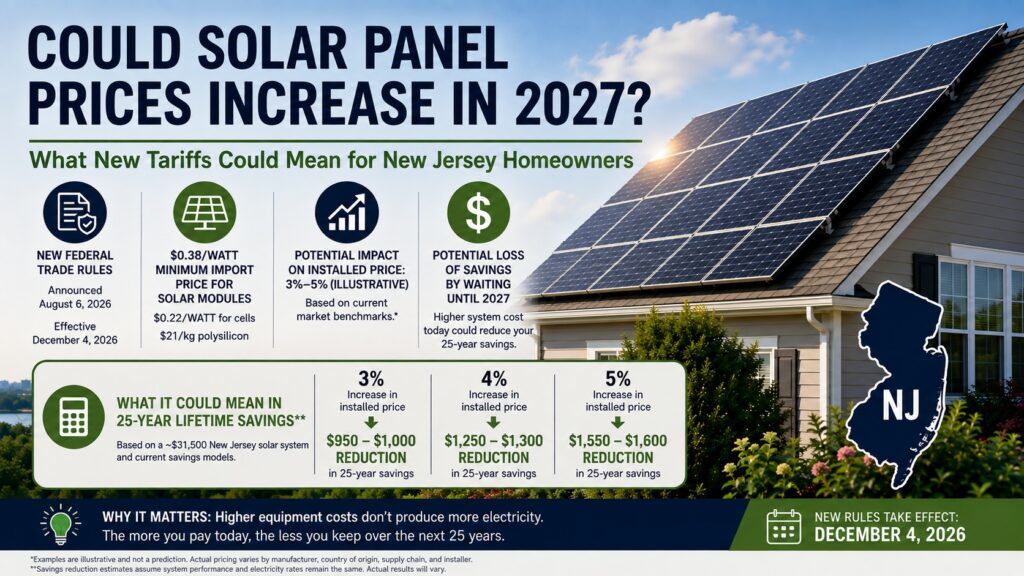
Could Solar Panel Prices Increase in 2027? What New Tariffs Could Mean for New Jersey Homeowners
If you've been considering solar for your New Jersey home but haven't moved forward yet, 2026 may turn out to be an important year to make a decision.
On August 6, 2026, President Trump issued a new federal proclamation affecting imports of polysilicon and products made from it—including solar cells and solar modules.
The new rules are scheduled to take effect on December 4, 2026.
Among the biggest changes is a new $0.38-per-watt minimum import price for covered solar modules, along with a $0.22-per-watt minimum import price for solar cells and an additional 15% tariff on covered polysilicon derivatives, subject to the specific provisions and country treatment contained in the proclamation.
What could that mean for a New Jersey homeowner?
There is now a legitimate reason to believe some solar equipment could become more expensive heading into 2027.
And if the cost of installing essentially the same solar system increases, the homeowner doesn't receive more electricity in return.
The result could simply be:
Higher solar price. Higher financing cost. Lower long-term savings.
That's why homeowners who are already considering solar should think carefully before assuming that waiting until 2027 will result in a better deal.
2026 SOLAR TAKEAWAY
New federal solar trade rules take effect December 4, 2026. While nobody can guarantee exactly how much residential solar prices will change, current market pricing shows that some affected equipment could face upward cost pressure.
In our simplified scenarios, that could translate into roughly a 3% to 5% increase in the total installed price of a New Jersey residential solar system.
On a roughly $31,500 system, that's approximately $950 to $1,600 in additional cost—and potentially $950 to $1,600 less in 25-year net solar savings, assuming everything else remains equal.
If solar already makes financial sense for your home in 2026, waiting because you assume it will automatically be cheaper in 2027 may carry a real financial risk.
What Changed on August 6, 2026?
President Trump issued a White House proclamation on August 6, 2026 titled “Adjusting Imports of Polysilicon and its Derivatives into the United States.”
The action followed a Section 232 investigation by the U.S. Department of Commerce.
The new policy establishes minimum import prices for several important parts of the solar manufacturing supply chain:
- Polysilicon: $21 per kilogram
- Polysilicon ingots and wafers: $100 per kilogram
- Solar cells: $0.22 per watt
- Solar modules: $0.38 per watt
The proclamation also imposes an additional 15% tariff on covered polysilicon ingots and derivatives, except where different treatment applies under the proclamation.
The major changes take effect for covered products entering the United States beginning December 4, 2026.
Homeowners don't need to become experts in international trade policy to understand the potential impact.
The important point is:
The federal government is changing the pricing rules for important parts of the solar supply chain just as the industry heads into 2027.
Why December 4, 2026 Matters
December 4 is not a date when every solar company in America will automatically raise its prices.
That's not how the solar supply chain works.
Different companies have different:
- equipment inventories
- manufacturers
- distributors
- purchasing agreements
- countries of origin
- supply chains
- purchasing volumes
Some companies may already have equipment secured.
Some manufacturers may absorb part of an increase.
Some products may be affected differently than others.
Domestic manufacturing could also help offset some of the pressure over time.
But there is an important difference between saying “we don't know exactly what prices will do” and saying “nothing is changing.”
Something significant is changing.
The new federal pricing and tariff structure begins December 4.
That creates a legitimate financial reason for homeowners already considering solar to evaluate the numbers available in 2026 rather than automatically waiting until 2027.
Why Waiting Until 2027 Could Cost You More
For years, homeowners have heard that solar technology keeps improving and solar panels tend to become less expensive over time.
That can lead to a reasonable question:
“Why shouldn't I just wait another year?”
The August 2026 trade action changes that calculation.
Waiting still could work in your favor.
But there is no guarantee that it will.
In fact, there is now a known federal policy change that could put upward pressure on the cost of some solar equipment beginning in December.
To understand the potential impact, let's look at today's numbers.
Solar Modules Could See a Significant Cost Increase
Recent 2026 solar-industry market data has shown median U.S.-assembled solar module pricing at approximately $0.30 per watt.
The new federal minimum import price for covered solar modules will be:
$0.38 per watt
Compare the two:
$0.30 → $0.38 per watt
That's an increase of:
$0.08 per watt
Or approximately:
27% at the module level
Some imported equipment has recently been priced even lower.
If you compare $0.265 per watt with the new $0.38-per-watt minimum, the difference is approximately:
43%
Those are big percentages.
But this is where homeowners need to be careful.
A 27% Increase in Solar Panel Cost Does NOT Mean Your Solar Installation Costs 27% More
The solar panels themselves are only one part of a residential solar installation.
As the U.S. Department of Energy explains, a complete photovoltaic system includes more than the modules themselves. It also requires mounting structures and equipment that converts the electricity generated by the panels into electricity your home can use.
A residential installation can include:
- solar panels
- inverters or microinverters
- racking and mounting equipment
- electrical equipment
- engineering
- permits
- utility interconnection
- installation labor
- transportation
- monitoring
- insurance
- warranties
- service
- business overhead
So even if the cost of the solar module increases substantially, the percentage increase in the complete installed system should be much smaller, assuming other project costs remain relatively stable.
That's the number homeowners should really care about.
What Could the Price Increase Actually Look Like?
Let's use a simple example.
According to EnergySage's July 2026 New Jersey solar pricing data, the average installed residential solar price in New Jersey is approximately:
$2.56 per watt
Imagine a 10 kW solar system, or 10,000 watts.
At $2.56 per watt, the complete system would cost approximately:
$25,600
Now assume the modules used for that system increase from $0.30 per watt to the new $0.38-per-watt minimum.
That's an increase of:
$0.08 per watt
Across 10,000 watts:
$0.08 × 10,000 = $800
If that entire additional equipment cost were passed through to the homeowner and everything else remained equal, the system would move from:
$25,600
to approximately:
$26,400
That's about a:
3.1% increase in the total installed price
So in this simplified example:
Solar module increase: approximately 27%
Total installed solar price increase: approximately 3.1%
That is a much more useful way for homeowners to think about the potential impact.
Could the Total Solar Price Increase Even More?
Possibly.
Let's use the lower $0.265-per-watt module benchmark.
Moving from:
$0.265/W → $0.38/W
creates a difference of:
$0.115 per watt
Across a 10,000-watt system:
$0.115 × 10,000 = $1,150
Compared with our $25,600 example system, that's approximately a:
4.5% increase in the total installed price
This is why we believe a 3% to 5% installed-price scenario is useful for homeowners to consider.
But it is important to understand exactly what we're saying.
We are NOT predicting that every New Jersey solar system will increase 3% to 5% in 2027.
These are simplified scenarios based on current module prices, the new federal minimum import price, and current New Jersey installed solar pricing.
The actual impact could be lower.
It could be higher.
Some equipment may experience little or no immediate change.
The point is not to predict an exact future price.
The point is to understand that waiting now carries a measurable financial risk that did not exist in the same way before the new trade rules were announced.
What Could Waiting Until 2027 Cost on an Average New Jersey Solar System?
Now let's turn those percentages into actual dollars.
Current New Jersey solar pricing data from EnergySage puts the average residential solar installation at approximately:
12.32 kW
with an average installed price of approximately:
$31,549
Let's see what happens if that price increases.
If Solar Costs Increase 3%
$31,549 × 3% = approximately:
$946 more
If Solar Costs Increase 4%
$31,549 × 4% = approximately:
$1,262 more
If Solar Costs Increase 5%
$31,549 × 5% = approximately:
$1,577 more
So in our modeled scenarios, waiting until 2027 could potentially mean paying approximately:
$950 to $1,600 more
for essentially the same size solar installation.
Again, that's not a guaranteed 2027 price increase.
But it's a financial possibility homeowners should understand before deciding that waiting is automatically the safer choice.
Higher Solar Prices Can Mean Lower 25-Year Savings
Here's where the impact becomes even more important.
Suppose you have two identical solar systems.
They are the same size.
They produce the same amount of electricity.
They have the same equipment.
They operate for the same number of years.
But one costs $1,500 more.
The more expensive system doesn't produce $1,500 more electricity.
Assuming everything else remains equal, the homeowner simply begins with approximately:
$1,500 less potential net savings.
That's why the cost of waiting shouldn't be measured only by what you pay for the system.
It should also be measured by what you potentially give up in long-term savings.
What Could This Do to 25-Year Solar Savings?
EnergySage currently estimates that the average New Jersey homeowner could save approximately:
$65,878 over 25 years
by going solar, based on its current methodology and assumptions.
Now apply our potential price-increase scenarios.
If the system costs approximately $946 more, potential net savings could fall by roughly $946, all else equal.
If it costs approximately $1,262 more, potential net savings could fall by roughly $1,262.
If it costs approximately $1,577 more, potential net savings could fall by roughly $1,577.
Using the 5% scenario:
Current estimated 25-year savings: $65,878
Potential additional system cost: $1,577
Adjusted illustrative savings: approximately $64,301
That's approximately a 2.4% reduction in modeled 25-year net savings simply because the system cost more.
The system doesn't need to perform worse.
Your roof doesn't need to change.
The panels don't need to produce less electricity.
You simply paid more to get essentially the same energy production.
Waiting Could Cost More Than $1,600 If You're Financing Solar
There's another important piece of the equation.
Interest.
Suppose your solar system costs $1,500 more in 2027.
If you're paying cash, the additional cost is approximately $1,500.
But if you're financing the solar system, you're also financing that additional $1,500.
Depending on the interest rate and loan term, you may ultimately pay more than $1,500 for that increase.
That means the effect of higher equipment costs can potentially become:
Higher system price → Higher amount financed → More interest → Lower overall savings
This is why homeowners should compare the total cost of financing, not simply the monthly payment.
Green Sun provides homeowners with several solar lease, loan, and purchase options so you can compare the economics of different ways to go solar.
What About Waiting if You're Considering a Solar Lease?
A solar lease works differently.
The homeowner generally isn't purchasing the solar panels directly.
The company that owns the solar system purchases the equipment and incorporates those costs into the economics of the lease.
Large solar providers may have advantages such as:
- long-term equipment contracts
- substantial purchasing volume
- existing inventory
- negotiated manufacturer pricing
- multiple supply sources
That means the impact of the new trade rules could be different for a lease than for a cash or financed purchase.
However, higher equipment costs can still potentially affect the economics available from third-party solar providers.
That's why homeowners comparing leases should look carefully at:
- starting monthly payment
- starting electricity rate, if applicable
- annual escalator
- total projected payments
- estimated production
- equipment
- warranties
- service obligations
- end-of-term terms
A 0%-escalator solar lease may also be worth comparing because the payment does not automatically increase every year under an annual escalation schedule.
You can review Green Sun's New Jersey solar lease and purchase options to see how cash purchases, financing, and leases differ.
The important point is:
Don't assume one payment method will automatically be protected from changing solar equipment costs. Compare the actual offers available in 2026.
What Is Polysilicon and Why Does It Matter?
You may be wondering why a federal action involving something called polysilicon matters to a homeowner putting panels on a roof in New Jersey.
Polysilicon is a highly purified form of silicon.
It is a basic raw material used in the manufacturing of most traditional crystalline-silicon solar panels.
The U.S. Department of Energy's solar manufacturing guide explains how polysilicon fits into the manufacturing process.
A simplified version looks like this:
Polysilicon → Ingots → Wafers → Solar Cells → Solar Modules
In other words, polysilicon is near the beginning of the supply chain.
The new federal action reaches multiple stages of that chain.
The minimum import prices include:
Polysilicon: $21/kg
Ingots and wafers: $100/kg
Solar cells: $0.22/W
Solar modules: $0.38/W
The federal government is therefore not changing the rules for just one finished solar product.
It is addressing several stages of the solar manufacturing supply chain.
For homeowners who want to understand the bigger picture, the Department of Energy also provides an overview of U.S. solar manufacturing trade and policy measures.
What About the Additional 15% Tariff?
The proclamation also establishes an additional 15% ad valorem tariff on covered polysilicon ingots and derivatives.
“Ad valorem” simply means the tariff is based on a percentage of the product's value.
However, homeowners should not interpret this as:
“Every solar panel gets another 15% added to its price.”
That's not how the policy works.
The federal action includes specific product classifications, rules, and different treatment for certain trading partners.
That's another reason nobody can responsibly say today:
“All solar systems will increase exactly X% in 2027.”
The impact will depend on the equipment and supply chain.
The Government Is Also Trying to Prevent Stockpiling
There is another important part of the August 6 federal action.
The Commerce Department is directed to monitor for stockpiling before the December 4 effective date.
In plain English, the government does not want companies simply importing unusually large quantities of covered products before the new rules begin as a way to avoid the new pricing structure.
Why does that matter to homeowners?
Because it reinforces an important point:
December 4 is intended to be a meaningful change in how covered solar products enter the United States—not merely a date on paper.
Why Won't Every Solar Installer Be Affected the Same Way?
This is another reason homeowners should be careful with blanket predictions.
Solar installers don't all buy equipment the same way.
Existing Inventory
One installer may already have substantial equipment inventory.
Another may purchase panels shortly before each installation.
Manufacturer Relationships
Long-term manufacturer and distributor relationships can influence pricing and equipment availability.
Purchasing Volume
Companies purchasing large volumes of equipment may have different pricing agreements.
Domestic Manufacturing
Equipment manufactured in the United States may have a different exposure to import-related costs.
Existing Contracts
Some manufacturers, distributors, or installers may already have contracts covering future equipment purchases.
Equipment Selection
Not every solar panel uses the same supply chain.
Different manufacturers and product lines may therefore experience different effects.
The result?
There may not be one universal “2027 solar price.”
Different installers could be quoting very different numbers.
Should You Go Solar Before December 4, 2026?
If solar doesn't make sense for your home, a tariff isn't a reason to install it.
If the proposal is overpriced, don't sign it.
If you don't understand the agreement, don't sign it.
But if you've already:
- received a solar proposal
- determined your roof is suitable
- reviewed the equipment
- looked at expected production
- compared payment options
- determined solar makes financial sense
then the decision to simply wait until 2027 deserves another look.
Before August 6, you might have reasonably assumed another year would simply bring newer equipment and lower prices.
Today, we know something we didn't know before:
A significant federal trade-policy change is scheduled to begin December 4, 2026.
That doesn't guarantee higher prices.
But it does increase the financial risk of waiting.
If you're still evaluating your options, Green Sun's Solar FAQs and Buyer's Guide can help you understand equipment, incentives, system design, payment options, and long-term savings before making a decision.
Beware of the Wrong Kind of Tariff Sales Pitch
We believe there is a legitimate reason for homeowners to consider acting in 2026.
That doesn't mean every sales tactic is legitimate.
If someone tells you:
“Sign tonight or your solar system is going up 30% tomorrow!”
be skeptical.
A 27%, 30%, or 40% change in the cost of one component is not the same thing as a 27%, 30%, or 40% increase in the complete installed price.
Ask the salesperson to show you:
- actual system price
- price per watt
- exact solar panels
- exact inverter
- projected annual production
- payment terms
- warranties
- projected savings
And then ask:
“How exactly are the new trade rules changing my total installed price?”
A reputable installer should be willing to explain the numbers.
Why Acting in 2026 May Make Financial Sense
The argument for moving forward in 2026 isn't:
“Solar prices are definitely going through the roof.”
We don't know that.
The argument is:
We now know that federal trade rules affecting solar equipment are changing on December 4, 2026.
We know the new minimum import price for covered solar modules is $0.38 per watt.
We know recent module prices in parts of the market have been around $0.30 per watt.
We know a higher module cost can work its way into the total installed price.
And we know that paying more for essentially the same energy production reduces the homeowner's potential net savings.
Our simplified modeling suggests that a 3% to 5% increase in total installed price could add roughly:
$950 to $1,600
to an average-priced New Jersey solar installation.
And if everything else remains equal, that's potentially:
$950 to $1,600 less in 25-year net solar savings.
For homeowners who already know they want solar, that's a legitimate reason to consider moving forward while 2026 pricing is still available.
Why Working With a Local New Jersey Solar Installer Matters
Trade policy happens in Washington.
Your solar installation happens on your home.
New Jersey municipalities have their own permitting requirements.
Utilities have their own interconnection processes.
Homes have different roofs, electrical systems, shading, structural conditions, and energy usage.
An experienced local installer should understand those details before your project begins.
Established installers may also have long-standing relationships with equipment manufacturers and distributors, which can become increasingly valuable when supply chains and pricing change.
And there is another question worth asking:
Who will be there after the panels are installed?
Can you speak with a real person?
Does the company service the systems it installs?
Does it understand your utility?
Does it have experience with New Jersey permitting and inspections?
Will it still be available if you need service years from now?
Green Sun Energy Services, LLC is headquartered in Middletown, New Jersey and has been serving homeowners since 2010.
Our goal isn't to convince homeowners to install solar because they're afraid of tariffs.
It's to help homeowners understand that the economics of waiting have changed.
The Bottom Line: 2026 May Be the Better Time to Go Solar
Nobody can guarantee what solar panels will cost in 2027.
But homeowners don't have to guess about everything.
We know the new federal solar trade action was announced on August 6, 2026.
We know the new rules are scheduled to take effect December 4, 2026.
We know the federal minimum import price for covered solar modules will be $0.38 per watt.
And we know that if higher equipment costs are passed through to homeowners, the final installed price can increase.
Using today's New Jersey solar pricing as a benchmark, our simplified scenarios show how a 3% to 5% increase could mean roughly:
$950 to $1,600 more for solar
and therefore potentially:
$950 to $1,600 less in 25-year net savings
assuming everything else remains equal.
Could prices remain stable?
Yes.
Could manufacturers, distributors, domestic production, inventory, or purchasing agreements absorb some of the impact?
Absolutely.
But should homeowners automatically assume waiting until 2027 will get them a cheaper solar system?
No.
If you're already considering solar and the numbers make sense for your home today, there is now a legitimate financial reason to consider completing that decision in 2026.
Waiting has a potential cost.
And the longer you wait to start producing your own electricity, the longer you continue purchasing all of your electricity from your utility.
Before deciding to wait another year, compare the numbers available today with the potential cost—and potential lost savings—of waiting until 2027.
If you're ready to see what solar looks like for your home, contact Green Sun Energy Services for a solar estimate based on your actual home and electricity usage.
Frequently Asked Questions
Will solar panels definitely cost more in 2027?
No. Nobody can responsibly guarantee that every solar system will cost more in 2027. However, new federal minimum import prices and tariffs taking effect December 4, 2026 could put upward pressure on some solar equipment costs.
How much could New Jersey solar prices increase in 2027?
The exact increase is unknown. Using current module prices and New Jersey installed solar pricing, our simplified scenarios show how certain module-cost increases could translate into roughly a 3% to 5% increase in the total installed price. This is an illustration, not a forecast.
How much could waiting until 2027 cost a New Jersey homeowner?
Using a current average New Jersey system price of approximately $31,549, a 3% increase would equal about $946, while a 5% increase would equal about $1,577. If everything else remained equal, that additional cost could reduce 25-year net solar savings by a similar amount.
When do the new federal solar trade rules begin?
The new minimum-import-price program and additional tariff provisions generally take effect for covered products entering the United States beginning December 4, 2026.
Should I go solar in 2026 instead of waiting until 2027?
If solar already makes financial sense for your home, the new federal trade rules are a legitimate factor to consider before waiting. They do not guarantee higher prices, but they create a potential source of upward equipment-cost pressure beginning in December 2026. Homeowners should compare today's actual solar price, equipment, production, payment options, and projected savings before deciding.
Sources and Further Reading
For homeowners who want to dig deeper into the underlying information used in this article:
- The White House: August 6, 2026 proclamation, Adjusting Imports of Polysilicon and its Derivatives into the United States
- U.S. Department of Energy: Solar Photovoltaic Manufacturing Basics
- U.S. Department of Energy: Overview of Trade and Policy Measures for U.S. Solar Manufacturing
- EnergySage: New Jersey Solar Panel Cost: 2026 Prices and Savings
The price and savings examples in this article are illustrative scenarios, not predictions or guarantees. Actual solar prices and savings depend on equipment, system design, utility rates, financing, incentives, installation costs, supply chains, and other factors.