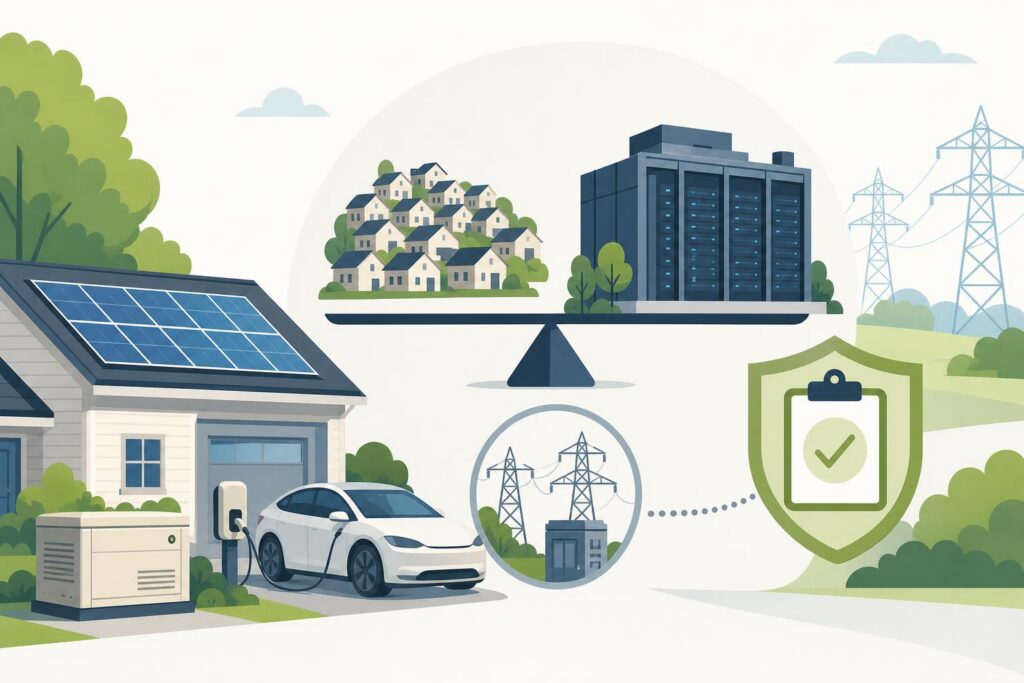
Illustration for the article How AI Data Centers Are Raising Your New Jersey Electric Bill — and What the State Is Doing About It

How AI Data Centers Are Raising Your New Jersey Electric Bill — and What the State Is Doing About It

Summary If your New Jersey electric bill jumped 17 to 20 percent on June 1, 2025, you were not imagining things — and data centers running artificial intelligence workloads bear a large share of the blame. According to the independent market monitor for the PJM grid that serves New Jersey, data centers were responsible for 63 percent of the cost increase in the most recent capacity auction, translating to roughly $9.3 billion passed on to customers across the PJM region in higher electric rates. To understand the scale of the problem: a single hyperscale data center drawing 100 megawatts of […]

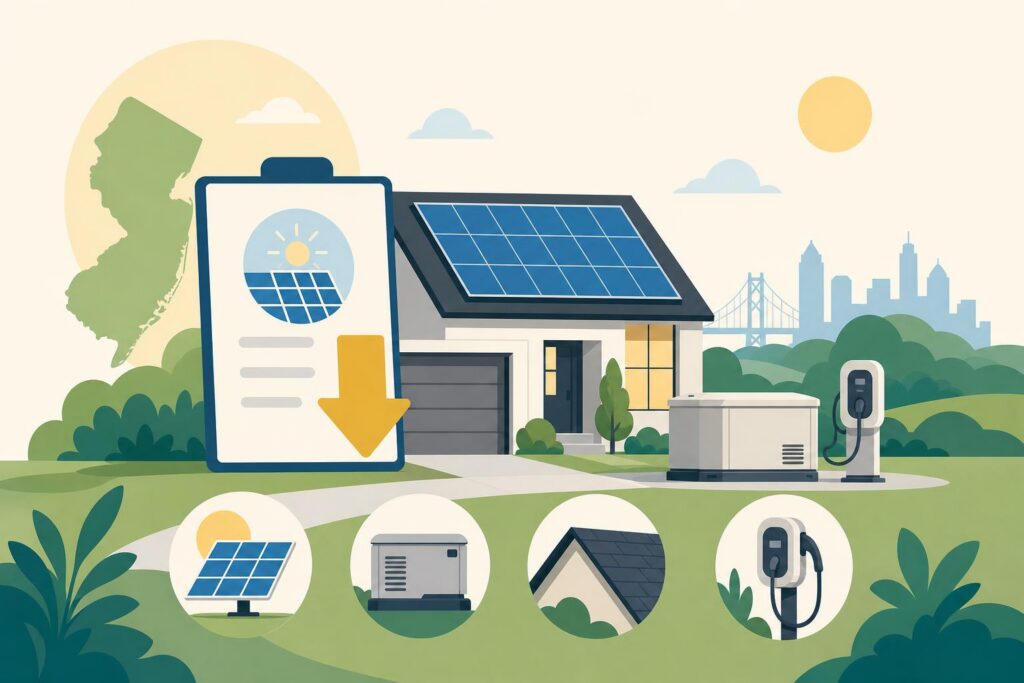
Illustration for the article NJ SREC-II Incentive Drops to $77/MWh: What Monmouth County Homeowners Need to Know

NJ SREC-II Incentive Drops to $77/MWh: What Monmouth County Homeowners Need to Know

Summary The New Jersey Board of Public Utilities (NJBPU) voted on May 21, 2026 to reduce the residential Administratively Determined Incentive (ADI) — the program most homeowners know as SREC-II — from $85 to $77 per megawatt-hour. That new rate applies to any residential solar system whose registration is received on or after July 27, 2026. Systems registered before that date remain locked at the higher $85 rate for their full 15-year incentive term. The $8 per MWh difference is modest on a monthly basis, but because the incentive qualification life is 15 years and one certificate is earned for

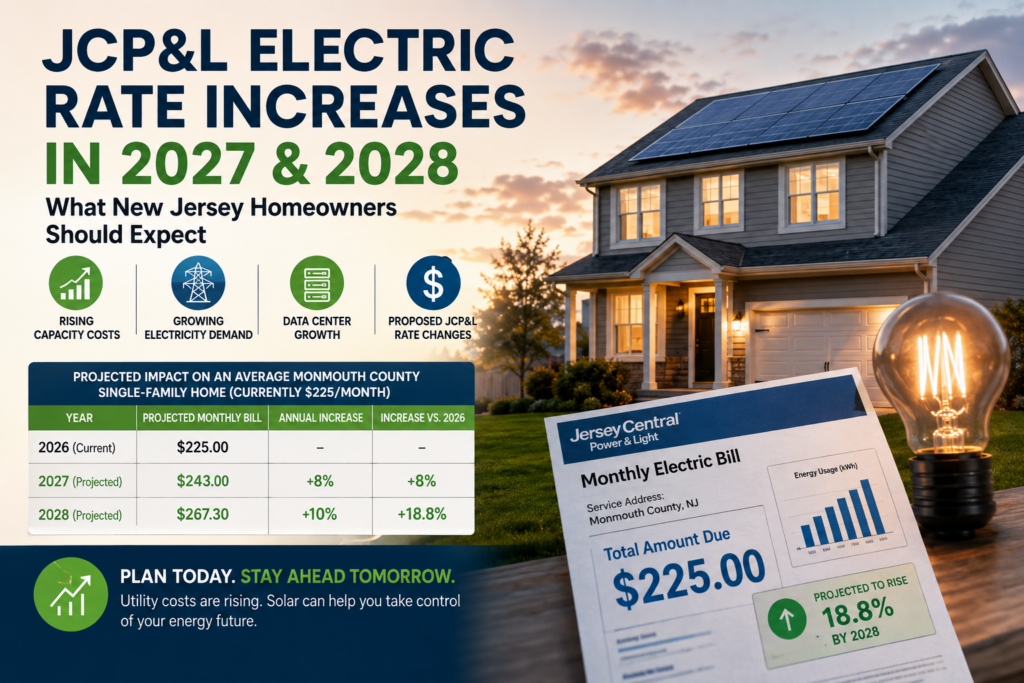
JCP&L rate increase 2027 and 2028 projection showing higher electric bills for a Monmouth County NJ home

JCP&L Electric Bills Could Climb Again: What NJ Homeowners Should Expect in 2027 & 2028

JCP&L Electric Rate Increases in 2027 and 2028: What New Jersey Homeowners Should Expect Electricity costs have already risen sharply for New Jersey homeowners, and the latest information from the New Jersey Board of Public Utilities (NJBPU), PJM Interconnection and Jersey Central Power & Light (JCP&L) suggests that 2027 and 2028 could bring additional increases. Based on currently available information, Green Sun Energy Services believes homeowners should consider the possibility of approximately an 8% increase in 2027 followed by another 10% increase in 2028 when planning future household electricity expenses. These are planning projections—not approved future JCP&L rate increases. For

New Jersey solar panel prices in 2027 and the potential impact of new federal solar tariffs

Are Solar Prices Going Up in New Jersey in 2027?

Why Waiting Until 2027 to Go Solar Could Cost New Jersey Homeowners More Could Solar Panel Prices Increase in 2027? What New Tariffs Could Mean for New Jersey Homeowners If you’ve been considering solar for your New Jersey home but haven’t moved forward yet, 2026 may turn out to be an important year to make a decision. On August 6, 2026, President Trump issued a new federal proclamation affecting imports of polysilicon and products made from it—including solar cells and solar modules. The new rules are scheduled to take effect on December 4, 2026. Among the biggest changes is a

Hurricane preparedness in New Jersey with standby generator protecting home during storm

Hurricane Preparedness NJ: What Homeowners Should Do Before June 1

Hurricane Preparedness in New Jersey: What Homeowners Should Do Before June 1 Hurricane season officially begins June 1, and while New Jersey isn’t Florida, we’ve seen firsthand how damaging storms can be—from Superstorm Sandy to more recent severe weather events. Power outages, flooding, and wind damage can happen quickly, and the difference between stress and peace of mind often comes down to preparation. If you live in New Jersey, here’s how to get ahead of the season and protect your home, your family, and your power. Why Hurricane Prep Matters in New Jersey Many homeowners underestimate storm risk in NJ—but

Solar battery vs generator comparison in New Jersey showing Tesla Powerwall, Enphase battery, and Generac standby generator in winter and summer conditions

Solar + Battery vs Generator in New Jersey

Cost, Reliability, and Backup Performance Explained Introduction When the power goes out in New Jersey, homeowners aren’t thinking about electric bills—they’re thinking about keeping the lights on, the heat running, and the house livable. Today, there are two primary backup power options: Solar + Battery Backup (Tesla Powerwall, Enphase IQ Battery) Standalone Standby Generator (Generac) Most comparisons online mix in energy savings, incentives, and net metering—but in New Jersey, those factors don’t meaningfully impact backup decisions. This guide focuses on what actually matters: Which system works best during real outages—and what does it cost over 10 years? We will break

cash-vs-lease-solar-surprising-150k-difference-nj

Cash vs Lease Solar in 2026: What Happens If You Invest the Money Instead?

Should You Lease or Buy Solar in NJ? The $150K Decision Most Homeowners Miss If you’re comparing cash vs lease solar in NJ, you’ve probably heard this: “Buying solar with cash gives you the best return.” That’s often true—but it’s not the full story. There’s another question most homeowners never ask: What if you lease solar… and invest that money instead? This guide breaks down solar lease vs buy in NJ in simple terms so you can make the smartest financial decision. — How Solar Actually Saves You Money Before comparing cash vs lease solar NJ, let’s cover the basics.

https://greensunnj.com/about-green-sun-energy/trusted-local-partners-nj/

How to Interpret Your Solar Monitoring App: Microinverter Sizing, Clipping, and What Your System is Really Telling You

Executive Summary If you regularly check your solar monitoring app—whether it’s Enphase Enlighten, SolarEdge Monitoring, or another platform—you may have noticed: Your system doesn’t always hit the panel’s rated output Some days show a flat “plateau” at peak production Production varies even on sunny days All of this is completely normal. 👉 These patterns are the result of real-world conditions and intentional system design, not a problem. 👉 Your system is designed to maximize total energy—not peak output. Why Your Panels Rarely Hit Their Rated Output Most panels are rated: 430W 440W 460W These ratings are based on STC (Standard

Homeowner confused by repeatedly tripping GFCI and AFCI breakers near generator setup

Why Do My Breakers Keep Tripping? GFCI & AFCI Explained

Why Do My New Electrical Service Breakers Trip So Often? Executive Summary If your new electrical breakers keep tripping, it doesn’t always mean something is wrong. Modern breakers—especially GFCI and AFCI types—are designed to be very sensitive to protect your home from shock and fire hazards. Sometimes, they trip even when there’s no real danger. This is called a nuisance trip. Common reasons include: Sensitive electronics detecting small electrical changes Appliances like vacuums or LED lights creating electrical noise Generator power producing an “imperfect” electrical signal Moisture or long wiring runs The good news? These issues are very common, and

Electric vehicle charging at home compared with gasoline refueling at a pump

EV Charging vs Gas Cost Calculator: How New Jersey Drivers Can Estimate Real Fuel Savings

How New Jersey Drivers Can Estimate Real Fuel Savings Executive Summary Many New Jersey drivers are considering switching to an electric vehicle but want to understand the real-world cost difference between charging an EV and fueling a gasoline car. The EV Charging vs Gas Cost Calculator from Green Sun Energy Services allows homeowners to estimate weekly, monthly, and yearly driving costs using their local utility rates, current gasoline prices, and personal driving habits. Using the calculator athttps://greensunnj.com/ev-charging/ev-charging-vs-gas-calculator/drivers can compare EV charging costs to gasoline fuel expenses in minutes. The tool uses realistic vehicle efficiency data and typical New Jersey electricity

Scroll to Top