

Summary
Every November, thousands of New Jersey homeowners pull a ladder out of the garage and start hanging Christmas lights. It feels like a routine chore, and for a single-story ranch on flat ground on a dry afternoon it largely is. But the conditions in Monmouth County from mid-November onward — overnight frost, wet asphalt shingles, uneven lawn edges, and brisk winds off the coast — are not routine. They compound the ordinary risks of ladder work in ways that are worth understanding before you decide whether to climb.
According to the U.S. Consumer Product Safety Commission, roughly 14,900 people were treated in hospital emergency departments for holiday decorating-related injuries during the 2023 holiday season (November 1, 2022 through January 31, 2023), and nearly half of those incidents involved falls. The CPSC’s own data shows approximately 160 such injuries occurring every single day during the season. Ladder falls are the leading contributor, and the numbers have stayed stubbornly consistent for more than a decade of agency reporting.
This post is not meant to frighten anyone away from their holiday traditions. It is meant to give you a clear-eyed framework for the specific hazards that exist on a Monmouth County roofline in November: what frost does to shingle traction, why a two-story Colonial or Cape Cod roofline is a fundamentally different task from a one-story gutter run, how ground conditions under the ladder base multiply upper-end risk, and what questions to ask yourself before you commit to doing the job yourself. If those answers lead you toward a professional installer, Green Sun Energy Services handles holiday lighting installations across Monmouth County. If they lead you to DIY safely, this post will have done its job.
Read the full post for section-by-section analysis of each risk factor, a plain-English FAQ, and a bottom-line summary of what the numbers actually mean for a New Jersey homeowner.
What do the CPSC injury numbers actually say about holiday light hanging?
The U.S. Consumer Product Safety Commission tracks consumer-product injuries through its National Electronic Injury Surveillance System, which monitors emergency department visits at a sample of hospitals nationwide and uses that data to produce national estimates. Its November 2024 holiday safety release reported that during the 2023 holiday season (November 1, 2022 through January 31, 2023), about 14,900 people were treated in emergency rooms for holiday decorating-related injuries, with approximately 160 such injuries occurring every day during the season. Nearly half of all those incidents involved falls.
That figure has been consistent across multiple reporting years. The CPSC’s 2024 release covering the 2022 holiday season (November 1, 2021 through January 31, 2022) placed the number at about 14,800 ER-treated injuries, with over 40% of incidents involving falls. The pattern does not change much year to year, which tells you something important: this is not a spike driven by one unusual season. It is a predictable, recurring cost of the holiday decorating calendar.
Ladder falls are the leading mechanism. A detailed look at the injury data on what these injury numbers mean for NJ homeowners notes that ladders were the most commonly associated secondary product in holiday decorating incidents. That is not surprising: the task of reaching a roofline or gutter with a light string almost always involves a ladder, and most homeowners are not using one under the conditions — secured base, stable ground, correct angle, someone footing — that safety guidelines require.
The injuries themselves are not trivial. According to Bureau of Labor Statistics data cited by safety researchers, fractures, particularly of ankles and wrists, occurred in roughly 42% of ladder fall injuries, and head trauma was reported in approximately 28% of emergency visits from ladder falls. Falls from ladders at the heights typical of residential roofline work — even single-story heights — generate enough force to cause serious, lasting injury.
What does Monmouth County weather look like from mid-November onward, and why does it matter?
Monmouth County sits in USDA hardiness zone 7b along the central New Jersey coast. The median first fall frost in Monmouth County arrives around November 12, though in colder years it can appear as early as November 3. Frost probability data derived from NOAA climate station records shows that by early November there is already a meaningful chance of a 32-degree overnight low, and by mid-November that probability rises sharply.
November average high temperatures in Monmouth County run around 54°F, with overnight lows averaging 41°F and a mean temperature of roughly 48°F. That means a day that felt mild at noon — perfectly reasonable light-hanging weather on the ground — will have dropped below freezing by early morning. Any moisture that settled on your roof surface overnight, whether from rain, dew, or condensation, may still be frozen when you start work at 8 a.m.
That matters because frost on a roof surface behaves very differently from rain. When rain, dew, or ice is present on a roof, the coefficient of friction drops significantly compared to dry conditions, and workers are more likely to slip. The same physics that governs car tires on icy pavement governs your boot soles on a frosted shingle surface. A rubber sole on dry asphalt provides a coefficient of friction in the range of 0.6 to 0.7; on the slipperiest forms of ice that number can fall as low as 0.2 — well below any safe threshold for working at height.
December conditions in Monmouth County are harsher still. December average highs drop to around 45°F and overnight lows approach 33°F, meaning freeze-thaw cycles become a daily reality. A shingle surface that thawed to merely wet in the afternoon may be glazed with black ice by the time a homeowner attempts to work the following morning. Wind off the Atlantic adds an additional stability challenge at any working height.
What does frost and wet weather actually do to shingle traction?
Asphalt shingles in good condition provide reasonable traction when dry because the embedded rock granules create surface texture. But that traction profile changes materially once moisture enters the picture. Wet surfaces have lower coefficients of friction than dry surfaces, and the difference is pronounced enough that professional roofing safety standards treat rain, dew, and ice as independent, heightened-risk conditions.
Older shingles present a compounding problem. As shingles age, granules gradually come loose, and loose granules can make even a dry roof difficult to walk on without sliding. Wet loose granules after rain can make the surface more slippery still. One home inspection source notes that loose granules on wet shingles create a ball-bearing effect — the granules adhere to your boot sole rather than the shingle surface, reducing the contact friction that keeps you stable.
Cold temperatures add a brittleness risk to the surface itself. Very cold shingles can become less flexible and more susceptible to cracking, which means that both you and your roof pay a penalty for cold-weather foot traffic. Professionals who work roofs routinely — roofers, home inspectors — generally avoid frost-covered or icy roof surfaces entirely. Standard roofing guidance is clear: do not walk on a roof that is wet, frosted, icy, covered with moss, or littered with leaves and loose debris, as each of those conditions can reduce traction.
The practical implication for a homeowner hanging lights in mid-to-late November is that the surface conditions you encounter are not within your control the way they are in August. You cannot schedule frost away. You can check the morning temperature and decide not to climb, but that discipline requires knowing in advance what you are checking for — which is exactly the purpose of understanding the local frost calendar.
Why is a two-story roofline or a mature tree a fundamentally different task from a one-story gutter run?
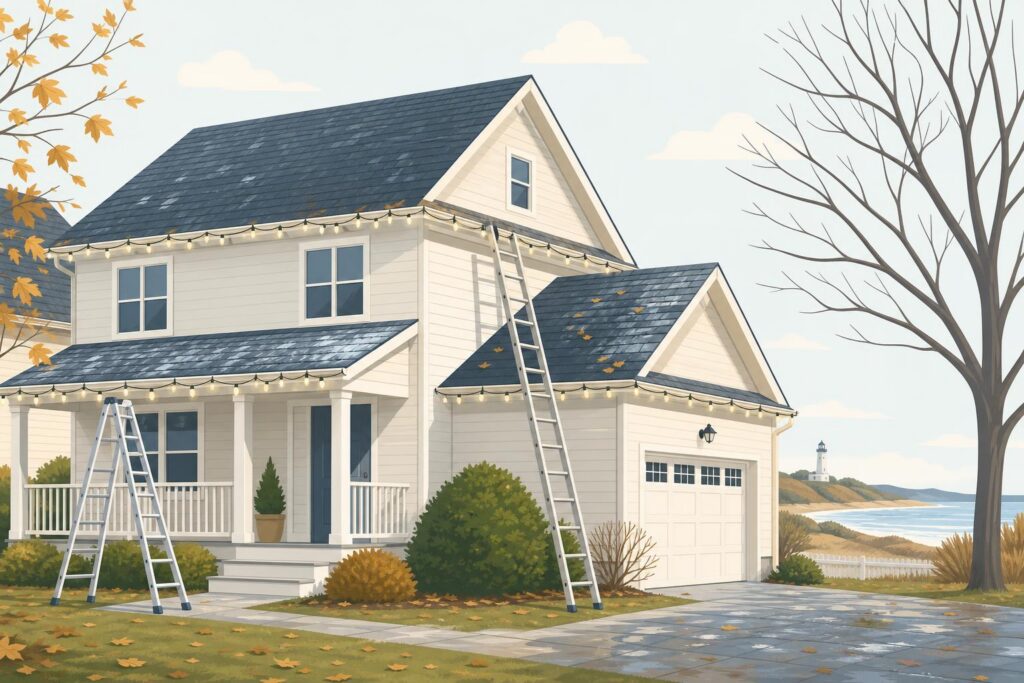
Height is the most direct amplifier of fall severity, and the difference between a one-story gutter run and a two-story Colonial or Cape Cod roofline is substantial. A standard two-story home typically has a gutter or eave height ranging from 18 to 22 feet above ground level. Reaching the peak of a Colonial or Cape Cod roof — which is often where homeowners want lighting — adds further height depending on the pitch.
Monmouth County’s housing stock is dominated by Colonial and Cape Cod styles, both of which carry steep roof pitches. Most NJ homes range from 4:12 to 12:12 pitch. Traditional Colonials typically run 8:12 to 10:12, while Cape Cods commonly reach 10:12 to 12:12. The general industry turnover point from manageable to dangerous roof pitch for an untrained person is around 7:12 to 8:12 — a threshold that many Monmouth County homes meet or exceed on their main roofline. OSHA classifies roofs steeper than 4:12 as “steep” for professional fall-protection purposes, and professionals working those pitches use safety equipment that a typical homeowner does not own.
The ladder itself grows more difficult to manage at two-story height. The industry-standard 4-to-1 setup ratio means that for every four feet of vertical height, the ladder base must be one foot out from the wall — so a 20-foot working height requires the base to be five feet away from the house. On a typical suburban lot, the base may land on a sloped lawn, a garden bed edge, a frost-softened patch of ground, or a concrete walkway that offers no purchase for the ladder feet. Any one of those conditions can initiate a base-slip failure.
Tree wrapping introduces a distinct set of problems. A mature oak or Norway spruce in a Monmouth County yard may put light-hanging work at 15 to 25 feet of height on surfaces — bark, branches — that offer no predictable grip, no flat landing, and no ability to set a ladder at the correct angle. The ladder base sits on ground that may be covered in damp leaves, root-raised soil, or frost. These are the conditions where CDC fall-injury data shows that nearly 90% of serious ladder fall injuries come from heights under 16 feet — meaning the tree you are wrapping, not just the two-story roofline, represents a real injury scenario. If you are considering a lightscaping approach that incorporates trees and multi-level features, the height and access complexity increases substantially from what a basic roofline outline requires.
What role does ground condition play, and why is Monmouth County's November terrain relevant?
Ladder falls do not always start at the top. A base-slip failure — where the ladder feet shift outward or sink into soft ground — is one of the most common failure modes, and it deposits the climber at whatever height they had reached at the moment of failure. Research tracking ladder accidents found that a ladder not secured at its top or bottom was a contributing factor in roughly 29% of residential falls. Unstable ground is an independent variable that interacts with everything above it.
Monmouth County soils in November present specific ground-condition challenges. The county’s predominant soil type is silt loam — Monmouth County receives approximately 39 inches of rainfall annually, and November is a shoulder month for precipitation as colder, wetter air masses begin to dominate. A week of November rain followed by a cold snap creates exactly the conditions for a ladder base to break through a frost-skin surface into soft, wet soil underneath. The ground looks solid; it is not.
Residential lots add topographic complexity that flat-ground safety assumptions miss. A sloped front yard, a raised garden bed edge along the foundation, a landscape timber border, a concrete walkway that sits an inch higher than the grass beside it — all of these create an uneven base plane that makes the 4-to-1 ladder angle difficult to achieve correctly. Slippery surfaces are estimated to account for roughly 23% of ladder accidents, and unstable ground accounts for approximately 15% of ladder collapses. These are not rare edge cases; they are routine contributors to the injury total.
The practical precaution is a level, firm, clear base area for the ladder feet. On many Monmouth County properties in November that requires actively clearing leaves and debris, identifying and avoiding soft spots, using a ladder leveler on uneven ground, and having a second person footing the base for the duration of the climb — not just the setup. If you cannot satisfy those conditions, the task has become meaningfully more dangerous regardless of how short the gutter run appears from the ground.
How do you assess your own roof pitch and working height before deciding to DIY?
A clear-eyed DIY decision starts with two measurements most homeowners have never made: the actual eave height of their roofline and the pitch of the main roof surface they plan to access. Neither requires professional tools.
Eave height can be estimated by counting stories and accounting for ceiling height plus floor structure. A single-story home with 9-foot ceilings typically has an eave at 10 to 12 feet. A two-story home typically has a gutter or eave height of 18 to 22 feet above ground. Ridge height adds further distance depending on pitch. If you are working a two-story gutter run, you are at a height where a fall produces severe outcomes at far higher rates than single-story work — and you need an extension ladder long enough to reach that height plus three feet of extension above the eave, set at the correct 4-to-1 base distance from the wall.
Roof pitch can be estimated with a level and a tape measure from inside the attic or from a ladder held at the eave. Pitch is expressed as the number of inches of rise for every 12 inches of horizontal run — an 8-in-12 pitch rises 8 inches vertically for every foot of horizontal distance. If your roof is a Colonial with an 8:12 or 10:12 main pitch, or a Cape Cod at 10:12 to 12:12, you are above the threshold where an untrained person without fall-protection equipment should be walking the surface. The job at that point is not a gutter clip run from a ladder; it involves stepping onto a surface that professionals treat as a fall-hazard zone requiring harness systems. You may also want to review what DIY light clips actually do to your gutters and shingles before deciding on your approach.
Weather is the third variable in the pre-work checklist. Check the overnight low for the previous night and the current morning. If it was at or below 32°F, assume the roof surface may still have frost on it, especially on north-facing slopes and in shaded areas. Check wind speed. OSHA and ladder-safety authorities consistently identify working in wind as a factor in ladder tip incidents. On a Monmouth County November morning with 10- to 15-mph onshore winds — average November wind speeds in the county run around 10 mph — a ladder at 20 feet becomes noticeably less stable than the same ladder on a calm summer afternoon.
What does the height research say about where most serious ladder injuries actually happen?
One of the most counterintuitive findings in ladder-fall injury research is where serious injuries are concentrated by height. The common mental model — that you need a dramatic fall from high up to be badly hurt — is not supported by the data. CDC analysis of emergency-department-treated ladder fall injuries found that falls from 6 to 10 feet caused about half of all cases, and nearly 90% of injuries came from heights under 16 feet. A one-story gutter run sits squarely in the most injury-dense band.
This matters because it reframes the risk calculus for homeowners who dismiss single-story work as low-stakes. The perception that low ladder work is low risk is precisely what generates the injury volume. A fall of 8 feet onto a concrete driveway or a frozen walkway can fracture a wrist, hip, or skull. Research published in the Journal of Surgical Research found that adults 66 and older fell from significantly lower average heights than younger adults — roughly 9 feet versus 12 feet — yet spent nearly twice as long in the hospital (7.3 days versus 3.8 days). Height and age interact: the same fall that is inconvenient at 40 can be life-altering at 65 or 70.
Two-story height does increase the severity profile, however. Falls from heights typical of two-story home roofline work — 10 to 20 feet — account for the majority of serious residential injuries requiring hospitalization. The forces involved at those heights are sufficient to cause compound fractures, spinal injuries, and fatal head trauma at rates that make prevention, rather than treatment, the only rational strategy.
The takeaway for a Monmouth County homeowner is that no height on a ladder in November, on a frosted or wet surface, with a potentially unstable base, is a casual undertaking. The difference between one story and two stories is a difference in degree, not a difference between safe and unsafe. Both deserve the same deliberate pre-work checklist. For those who prefer to hand the task to a professional team with the right equipment, that checklist is already built into how the job is executed.
What are the practical safety conditions a homeowner should meet before climbing in November?
If you have completed your pitch and height assessment and decided to hang lights yourself, the following conditions should all be met before you climb. These are drawn from OSHA ladder safety guidance, CPSC recommendations, and published roofing-industry fall-protection standards — not from a general spirit of caution.
Ground conditions: The ladder base must land on a firm, level, non-slippery surface. Clear all leaves, debris, and loose material from the base area. If the ground is frost-softened or uneven, use a ladder leveler or stabilizer board rated for your ladder’s weight capacity. Slippery surfaces were identified as a contributing factor in 36% of ladder accidents per OSHA analysis data, and that number is elevated in cold, wet, late-autumn conditions.
Ladder setup: Use the 4-to-1 angle rule — base distance equals one-quarter of the working height. When accessing a roofline or gutter, the ladder must extend at least three feet above the eave to provide a stable handhold for transition. Have a second person foot the base for the entire time you are on the ladder, not just during setup. Do not carry light strings or tool bags in your hands while climbing; use a tool belt or bucket hook.
Surface and weather: Do not climb onto a roof surface that is wet, frosted, icy, or covered with leaf debris. Check overnight low temperatures against the frost probability calendar. In Monmouth County, frost is a near-certainty from mid-November onward, meaning morning work on a north-facing slope or a shaded roofline carries a high probability of reduced traction without any visible cue from the ground. Avoid working in winds above approximately 10 mph at height. Finally, confirm whether your HOA has rules governing light installation timing and methods before you begin — some Monmouth County developments have restrictions that affect when and how exterior lighting can be installed.
Frequently Asked Questions
How many people are injured hanging Christmas lights each year?
According to the U.S. Consumer Product Safety Commission, about 14,900 people were treated in hospital emergency departments for holiday decorating-related injuries during the 2023 holiday season (November 1, 2022 through January 31, 2023). Nearly half of those incidents involved falls, and the CPSC estimates roughly 160 such injuries occurring every day during the season. The annual figure has remained in the 14,000 to 15,000 range across multiple recent reporting years.
Are Christmas light hanging ladder injuries mostly from high roofs or low ones?
Counterintuitively, most serious ladder fall injuries happen at low heights. CDC analysis found that falls from 6 to 10 feet caused about half of all emergency-department-treated ladder fall injuries, and nearly 90% of cases came from heights under 16 feet. A single-story gutter run is squarely in the most injury-dense height band, so dismissing it as low-risk is the most common mistake homeowners make.
When does frost start in Monmouth County, NJ?
Based on NOAA climate station data, the median first fall frost in Monmouth County arrives around November 12, though in colder years it can appear as early as November 3. Frost probability rises sharply through November, meaning that by mid-month a sub-freezing overnight low is more likely than not on any given night. That frost may still be on north-facing roof slopes and shaded surfaces well into the morning hours.
Is it safe to walk on wet or frosted asphalt shingles?
Professional roofing safety standards treat wet, frosted, and icy roof surfaces as independent fall-hazard conditions requiring extra precautions. The coefficient of friction on a wet or frosted surface is significantly lower than on a dry one, and loose shingle granules on wet surfaces create an additional slip hazard. Standard guidance from roofing professionals and safety organizations is to avoid walking on any roof surface that is wet, frosted, icy, or covered with debris.
What roof pitch is too steep for a homeowner to work on safely?
OSHA classifies any roof steeper than 4:12 as “steep slope” for fall-protection purposes, and professional roofers use harness systems on such surfaces. The general industry turnover point from manageable to dangerous for an untrained person without fall-protection equipment is around 7:12 to 8:12. Many Monmouth County Colonials run 8:12 to 10:12 and Cape Cods run 10:12 to 12:12 — both at or above that threshold.
How high is a typical two-story roofline in New Jersey?
A standard two-story home typically has a gutter or eave height of 18 to 22 feet above ground level. Reaching the ridge of a steeply pitched Colonial or Cape Cod adds further height depending on pitch and house width. At 20 feet of working height, a ladder set at the correct 4-to-1 angle requires the base to be five feet from the wall — and must extend three feet above the eave, meaning the actual ladder length needed is well above 24 feet.
What are the most common causes of ladder falls during holiday decorating?
Key contributing factors identified across OSHA, CDC, and Bureau of Labor Statistics data include: improper ladder angle (the base placed too close to the wall), slippery ground or roof surfaces, overreaching beyond the ladder’s side rails, carrying loads while climbing, and an unsecured ladder base. In November conditions in Monmouth County, slippery surfaces and unstable ground are especially elevated risk factors compared to the same task performed in dry summer conditions.
Should I hire a professional to hang Christmas lights on a two-story roofline?
That decision depends on your honest assessment of your roof pitch, the height involved, the ground conditions at your property in mid-to-late November, and whether you have a second person available to foot the ladder. If your home is a two-story Colonial or Cape Cod with a pitch above 7:12, if overnight temperatures have been dropping below freezing, or if the ground around your foundation is uneven or soft, a professional installer with appropriate equipment is a straightforward way to eliminate the risk. Green Sun Energy Services installs holiday lighting across Monmouth County — see their Christmas light installation page for details.
The Bottom Line
The Bottom Line
The case for taking Christmas light hanging ladder safety seriously in Monmouth County is not built on worst-case scenarios. It is built on consistent, well-documented injury data from the CPSC, a November frost calendar that puts sub-freezing overnight temperatures on your roofline starting around mid-month, steep roof pitches that are the norm rather than the exception on Colonial and Cape Cod homes throughout the county, and ground conditions that make the 4-to-1 ladder setup rule harder to satisfy than it looks on flat, dry pavement. None of those factors alone makes the task impossible. Together, they raise the risk profile of a November roofline job well above what most homeowners expect when they pull the ladder out.
The honest pre-work checklist is short: know your roof pitch, know your working height, check the overnight low, inspect the ground under your proposed base, and confirm you have a second person available for the full duration of the climb. If any of those boxes cannot be checked — if the pitch is above 7:12, if the eave is at 20 feet, if it frosted last night — the risk-benefit calculation shifts. Green Sun Energy Services provides professional holiday lighting installation across Monmouth County, using the right equipment for the actual conditions on your roofline. You can also read about completed projects on the featured clients page or hear from homeowners directly on the customer reviews page if you want a sense of how the service works before reaching out.
Green Sun is also Monmouth County’s installer for residential solar, Generac standby generators, and roofing — so if your November inspection of the roofline reveals something worth addressing before the lights go up, that conversation is available too.
Sources & Additional Information
- CPSC: Happy Holidays Start with Safety — November 19, 2024 Release
- CPSC: Make it a 'Home Safe Home' for the Holidays (2022 season data)
- Monmouth County, NJ — Planting Guide: Frost Dates (NOAA Data)
- Climate & Weather Averages in Monmouth County, New Jersey — TimeAndDate
- Roof Safety and Coefficient of Friction — Professional Roofing Magazine
- Is a 6/12 Roof Safe to Walk On? — JoylandRoofing.com
- Roof Pitch Guide: How Slope Affects Roofing Options and Cost in NJ — RandeRoofing
- What Size Ladder Do You Need for a 2-Story House? — EngineerFix
- DIY Roofing Injury Report 2026: Ladder Fall Data — TheRoofingBrief
- Are Ladders Dangerous? What the Injury Data Shows — ScienceInsights
- Ladder Accident Statistics — WifaTalents
- Fall Protection and Roof Safety: Roof Pitch Guide — WindowCleaner.com
- Are Asphalt Shingles Slippery When Wet? — HowToLookAtAHouse.com
- The Dangers of DIY Gutter Cleaning (Ladder Injury Stats) — CleanProGutterCleaning
- How to Choose the Right Ladder for a Two-Story House — EngineerFix