

Summary
Every holiday season, thousands of American homeowners climb ladders in cold, sometimes wet conditions to hang exterior lights — and a significant number end up in the emergency room because of it. According to the U.S. Consumer Product Safety Commission’s November 2024 holiday safety release, about 14,900 people were treated in hospital emergency departments for holiday decorating-related injuries during the 2023 holiday season (November 1, 2022 through January 31, 2023), with roughly 160 such injuries occurring every single day. Nearly half of all those incidents involve falls.
For a New Jersey homeowner, that number is not abstract. November rooflines in Monmouth County can be wet, windy, and slick with early-morning frost. A standard extension ladder on uneven ground, a slight overreach to clip one more strand, or a boot sole caked with mud from the yard — any one of these is the setup for the kind of accident that lands a person in the emergency room at Jersey Shore University Medical Center instead of at the Thanksgiving table.
This post walks through exactly what causes those falls, why cold-weather conditions in New Jersey compound each risk factor, and how professional installation eliminates the failure points that the data consistently identifies. It also puts the cost equation in plain terms: an average emergency room visit now runs well above $1,500, and that figure does not include lost wages, follow-up care, or the possibility of a long-term injury that changes daily life for months.
If you are weighing whether to hire someone to hang your lights this year, read the numbers first. The math may surprise you.
What does the CPSC data actually say about holiday decorating injuries?
The U.S. Consumer Product Safety Commission is the federal agency charged with tracking consumer-product injuries through its National Electronic Injury Surveillance System, which monitors emergency department visits at a sample of roughly 100 hospitals nationwide and uses that data to produce national estimates. Its November 2024 holiday safety release — issued specifically to warn consumers ahead of the decorating season — reported that during the 2023 holiday season (November 1, 2022 through January 31, 2023), about 14,900 people were treated in emergency rooms for holiday decorating-related injuries, with approximately 160 such injuries occurring every day during the season. Nearly half of all those incidents involved falls.
A separate analysis of CPSC surveillance data published by CNN in December 2024 found that an estimated 16,000 people head to the hospital for holiday-decor-related injuries each year, and that over two decades the total reached nearly 312,000 emergency room trips. The same analysis found that ladders were the most commonly associated secondary product, contributing to 17 percent of estimated hospital visits, and that men were twice as likely as women to be involved in ladder-related accidents.
The Electrical Safety Foundation International, drawing on earlier CPSC data, reports that roughly 5,800 people per year are treated in emergency rooms specifically for falls associated with holiday decorations, and more than half of those injuries are caused by falls from ladders or roofs while decorating outdoors. These are not slips on a rug while placing an ornament on a tree. They are falls from height, outdoors, on hard ground — the kind with consequences that go well beyond a bruise.
The takeaway from the federal data is consistent across years and agencies: the single biggest physical risk of holiday decorating is climbing a ladder in conditions that professional tradespeople would treat with considerable caution. For most homeowners, that risk is invisible until it is not.
Why is November ladder use in New Jersey particularly dangerous?
New Jersey’s late-autumn weather creates a combination of hazards that safety professionals specifically call out as compounding factors for ladder falls. Temperatures in Monmouth County from mid-November onward routinely drop below freezing overnight, and light frost can appear on rooflines, gutters, and ladder rungs by early morning — often invisible until a boot or hand makes contact with it. According to ladder safety guidance from EMC Insurance, cold weather introduces unique challenges including slippery surfaces and bulky clothing, and a majority of ladder injuries are caused by failure to take precautions during winter months.
The problem is not only on the rungs. As one winter ladder safety guide notes, snow hides uneven ground, creates slippery surfaces, and can freeze onto ladder rungs, drastically reducing grip for both hands and feet. A residential yard in November may have soft spots from recent rain, decorative edging that creates an uneven base, or leaf litter that compresses unexpectedly under a ladder foot. None of these conditions are visible from the top of the ladder, which is exactly where the homeowner is when things go wrong.
Cold temperatures also affect the equipment itself. Aluminum ladders — the type most homeowners own — conduct cold rapidly. One source on winter ladder use notes that aluminum ladders can become very cold at this time of year, which can affect grip and balance, particularly when a person is wearing gloves thick enough to keep hands warm. Fibreglass and plastic components can also become more brittle under sustained cold, increasing the risk of structural failure under load.
Finally, there is the timing pressure that November brings: homeowners tend to compress the decorating window between Thanksgiving and the first weekend of December. That rush — hanging lights when the weather gives a brief window, carrying multiple strands up at once, skipping the spotter because a family member is busy — is precisely the behavioral pattern that safety data associates with accidents. The most dangerous decorating period, according to CPSC-based analysis, is following Thanksgiving, when many people start to put up decor.
What are the specific ladder failure points that send homeowners to the ER?
Safety researchers and occupational health agencies have identified a consistent set of failure modes in ladder accidents, and they map almost perfectly onto what a homeowner faces when hanging exterior Christmas lights. Understanding each one is useful because it makes the risk concrete rather than theoretical.
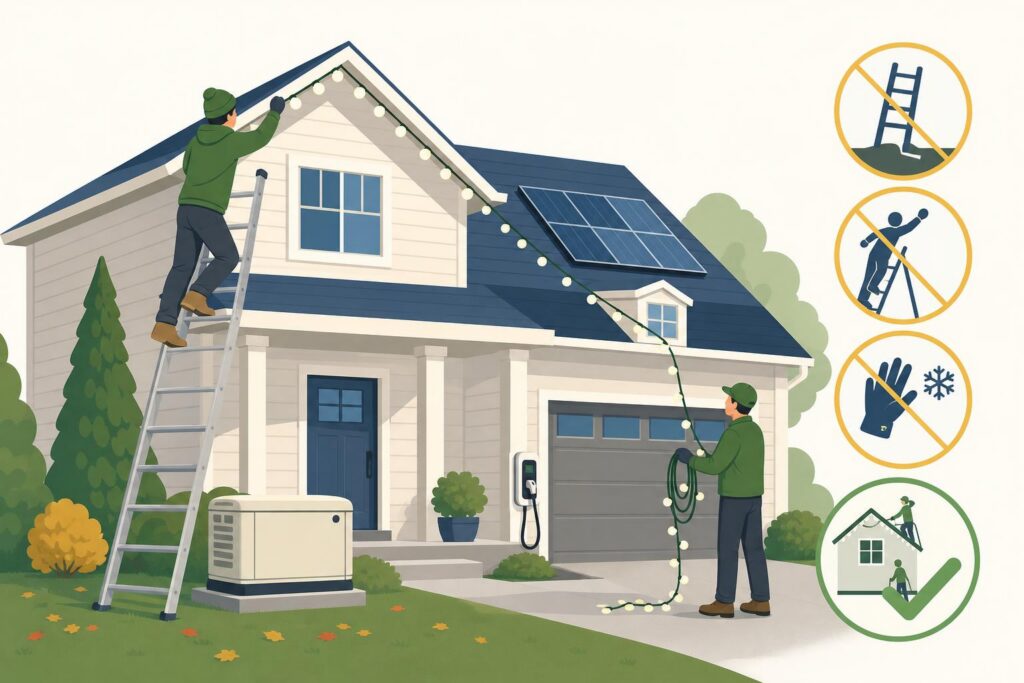
Unstable placement. The CPSC and OSHA both document unstable or improper ladder placement as a primary cause of falls. The correct angle ratio for an extension ladder is one foot of base distance for every four feet of height — a 16-foot placement point requires the base to be four feet from the building. The ladder base must also be positioned on a stable and level surface; placing a ladder on mulch, a sloped driveway apron, or a decorative stone border violates this requirement even if it feels stable at the start of the climb. One analysis of residential fall data found that the ladder was not secured at the top or bottom in 29 percent of residential falls, per CDC WISQARS data.
Overreaching. The University of Wisconsin Environmental Health and Safety program states directly that when climbing, you should keep your hips between the side rails and not lean too far or overreach, repositioning the ladder closer to the work instead. This is exactly what homeowners skip when they are near the end of a strand and want to avoid climbing down, repositioning, and climbing back up. Overreaching while on a ladder can cause it to tip, leading to potential injuries. The physics are straightforward: shifting body weight outside the ladder’s footprint moves the center of gravity past the tipping point.
Cold-weather grip failure. Falls can occur when workers place ladders on unstable surfaces, overreach on the ladder, or slip on rungs due to wet or icy conditions. Boot soles that are adequate for walking across a driveway can carry enough packed snow or mud to act as a lubricant on an aluminum rung. Before climbing, checking boot soles for snow, ice, or mud build-up is critical, because even a thin layer can act like a lubricant and cause a foot to slide. Most homeowners do not perform this check.
Carrying too much. A homeowner trying to be efficient will carry a full reel of lights, a staple gun or light clips, and possibly a second strand looped over a shoulder. Rushing through the decorating process often leads to careless errors, while carrying too much up the ladder compromises balance and stability. Removing one hand from the ladder to clip a strand is a textbook violation of the three-point contact rule that OSHA requires in professional settings.
How much does a holiday decorating injury actually cost a New Jersey homeowner?
The financial case for professional installation is clearest when the cost of an injury is expressed in concrete terms rather than as a general warning. Emergency room costs in the United States have risen substantially, and New Jersey’s hospital market is among the most expensive in the country.
According to UnitedHealthcare data cited by multiple healthcare cost sources, the average cost of an emergency room visit in the United States is around $2,600 without insurance. That is the baseline for an acute but non-critical visit. A fracture requiring imaging, casting, and an orthopedic consultation will carry additional charges. Costs can reach $20,000 or more for critical conditions requiring extensive testing or emergency surgery, and an ambulance ride, if needed, adds $500 to $1,300 on top of the facility bill.
Even an insured patient faces real out-of-pocket costs. If a homeowner has not met their annual deductible by late November — which is likely, since most deductibles reset January 1 — the entire ER visit cost up to that deductible limit comes out of pocket before insurance begins to share the burden. After the deductible, most plans still require coinsurance of 20 to 25 percent of the negotiated rate.
The financial picture extends beyond the hospital bill. A wrist fracture, a broken ankle, or a compressed vertebra from a rooftop fall can keep a working adult out of their job for weeks. Lost income, physical therapy copays, and the cost of hiring help for tasks the injured person cannot perform all compound the initial expense. Against that backdrop, the cost of having a professional installer handle the job — removing the ladder from the equation entirely — looks different than it does when weighed only against the price of doing it yourself on a Saturday afternoon.
How does professional installation eliminate each of the specific failure points?
Professional holiday light installation does not merely reduce the risk of the hazards described above — it removes the homeowner from the risk equation entirely. Each of the documented failure modes has a direct professional countermeasure.
Ladder placement and stability. Professional installers work from ladders routinely and understand angle ratios, ground assessment, and the importance of a spotter. They carry appropriate stabilizers, standoffs, and leg levelers for uneven surfaces. They do not place a ladder on the first patch of ground that looks convenient; they assess the site before any equipment goes up. The University of Wisconsin ladder safety guidance that tells climbers to keep hips between the side rails and reposition the ladder rather than overreach describes standard professional practice — it is not a constraint that requires discipline to follow each time, it is simply the way the work is done.
Cold-weather preparation. A professional crew arriving at a Monmouth County home in November comes with equipment suited to winter conditions: appropriate footwear, gloves compatible with the tasks being performed, and an awareness of frost and ice that comes from working outdoors year-round rather than from one annual trip up a household ladder. They also work in teams, which means one person is always monitoring conditions at the base while another is elevated.
Load management. Professionals stage their materials at the base and use proper tool belts or aprons designed for exterior work. They do not carry coiled light strands draped over both arms while trying to maintain three-point contact on a ladder. The choreography of the work is organized in advance — something that a homeowner doing the job once a year rarely replicates.
Equipment suitability. Household ladders are often the wrong height, the wrong type, or in a condition that a professional would not accept for elevated work. An extension ladder with worn rubber feet, a loose side rail, or rungs that have not been checked for hairline cracks since 2019 is not a safe tool for roofline work in November. Professional installers use and inspect their equipment regularly.
The result is that professional Christmas light installation converts a task that the CPSC identifies as one of the most injury-prone residential activities of the year into one where the homeowner is not involved in the physical execution at all. The lights go up; the homeowner stays on the ground.
When is the right time to book a professional installer in Monmouth County?
Timing matters almost as much as the decision itself. Professional holiday light installers in Monmouth County operate on a finite schedule between mid-October and late November, and the best installation windows fill up well before most homeowners start thinking about lights. The post-Thanksgiving rush — which is also, as CPSC data shows, the most dangerous decorating period of the year — is often when homeowners who did not book early find themselves either on a waiting list or deciding to do it themselves.
Green Sun Energy Services has written directly about this pattern for Monmouth County homeowners. As explained in the Why Monmouth County Holiday Light Installers Fill Up Before October post, the booking window for professional installation closes earlier than most people expect. Waiting until late November narrows the options sharply.
Booking early also means the installation happens when weather conditions are most cooperative — typically in October or early November before the first hard freezes — which makes the job safer for the crew and produces better results for the homeowner. Lights installed on dry gutters and fascia in mild weather seat and clip more cleanly than those rushed onto frost-covered surfaces in the last week before Thanksgiving.
If cost is a consideration, it is worth noting that the financial comparison is not only between the installation fee and the DIY cost of buying lights and clips at a hardware store. It is between the installation fee and the realistic cost of an injury: an ER bill, a deductible, time off work, and a recovery period that turns a single afternoon decision into months of consequence. Framed that way, early booking is not a luxury purchase — it is straightforward risk management.
What else should New Jersey homeowners know about holiday electrical safety?
Falls are the dominant injury category in the CPSC data, but they are not the only hazard associated with DIY exterior light installation. Electrical risks are a secondary but real concern, particularly when homeowners string together multiple extension cords or use lights rated for indoor use on exterior surfaces.
The CPSC advises consumers to never string together more than three sets of incandescent lights and never overload electrical outlets. In practice, a full roofline display on a two-story colonial in Monmouth County can easily draw enough current to trip a breaker or, in a worst case, to create a fire hazard in an outlet box that was not designed for sustained seasonal load. The Electrical Safety Foundation International reports that about 4,000 people per year are treated in emergency rooms for injuries associated with extension cords, with half of those injuries involving fractures, lacerations, contusions, or sprains from tripping over the cords.
Professional installers understand circuit capacity, use weatherproof-rated equipment for exterior runs, and route cords in ways that do not create tripping hazards across walkways and entry paths. For homeowners who have already made energy improvements — such as those who have worked with residential solar panels or had a Level 2 EV charger installed — protecting that electrical infrastructure with properly managed seasonal loads is an additional reason to have the work done by someone who understands residential electrical systems.
New Jersey’s nearly 20-percent electric rate increase also means that the energy consumption of an exterior light display carries a real dollar cost this season. Green Sun has published a dedicated analysis of what the NJ electric rate hike means for your holiday light bill — a useful read for homeowners trying to understand the full cost picture of their display before the first strand goes up.
Frequently Asked Questions
How many people are injured hanging Christmas lights each year?
According to the U.S. Consumer Product Safety Commission’s November 2024 holiday safety release, about 14,900 people were treated in hospital emergency departments for holiday decorating-related injuries during the 2023 holiday season (November 1, 2022 through January 31, 2023). A broader CNN analysis of CPSC data found an estimated 16,000 decorating-related ER visits per year across the United States. Nearly half of all holiday decorating injuries involve falls.
What are the most dangerous parts of hanging outdoor Christmas lights yourself?
The three most consistently documented failure points are unstable ladder placement (including setting a ladder on uneven, soft, or frozen ground), overreaching from the ladder instead of repositioning it, and grip failure caused by cold, wet, or icy rungs and boot soles. Falls from ladders or roofs account for more than half of all outdoor holiday decorating fall injuries, according to the Electrical Safety Foundation International citing CPSC data.
Is DIY Christmas light hanging more dangerous in cold weather?
Yes. Cold weather compounds several hazards simultaneously: frost on rungs reduces grip, frozen or snow-covered ground hides uneven surfaces under the ladder base, and bulky winter clothing can reduce a climber’s balance and their ability to maintain three-point contact. EMC Insurance’s cold-weather ladder safety guidance notes that a majority of ladder injuries are caused by failure to take proper precautions during winter months.
How much does an emergency room visit cost if I fall off a ladder?
According to UnitedHealthcare data, the average ER visit in the United States costs around $2,600 without insurance. With insurance, you may still owe the full amount up to your deductible, which typically resets each January — meaning a late-November fall could hit at the worst point in your deductible cycle. Serious injuries requiring imaging, surgery, or hospital admission can cost significantly more, and that figure does not include lost wages or follow-up care.
Does professional Christmas light installation eliminate the risk of falls?
Professional installation removes the homeowner from the elevated work entirely, which eliminates the homeowner’s personal exposure to the fall hazards the CPSC documents. Professional crews use properly inspected equipment, work in teams with spotters, assess site conditions before setting up ladders, and follow standard safety practices as a matter of routine rather than as an occasional precaution.
When should I book a professional holiday light installer in Monmouth County, NJ?
Booking in October or early November gives you the best chance of securing a preferred installation date. Professional installers in Monmouth County fill their schedules well before the Thanksgiving rush, which is also the statistically most dangerous period for DIY decorating injuries according to CPSC data. Green Sun Energy Services offers professional Christmas light installation in Monmouth County — contacting them early in the fall is the most reliable way to get on the schedule.
Are LED Christmas lights safer than traditional incandescent lights?
LED lights run cooler and draw significantly less current than incandescent strings, which reduces the risk of overloaded circuits and reduces fire hazard from contact with flammable materials. The CPSC advises against stringing more than three sets of incandescent lights together; LED strings typically allow more sets in series. However, LED lights do not reduce the fall risk associated with hanging them — the ladder hazard is the same regardless of bulb type.
What other home services does Green Sun Energy Services offer in Monmouth County?
Green Sun is a full-service Monmouth County home services company. In addition to holiday lighting installation, they install residential solar panels, Generac standby generators, roofing, EV chargers, and offer exterior soft washing services.
The Bottom Line
The Bottom Line
The CPSC’s own data makes the case plainly: holiday decorating sends roughly 14,900 Americans to the emergency room in a single season, and nearly half of those incidents involve falls. For a New Jersey homeowner in November — standing on a ladder propped against a wet fascia board, reaching for one more clip, wearing gloves that reduce grip and boots that may have frost on the soles — those statistics are not someone else’s problem. They describe exactly the conditions that the federal data flags as the highest-risk scenario in residential decorating. An emergency room visit, a fracture, or a week of lost work is an expensive outcome for a task that lasts a few hours.
The alternative is straightforward. Professional Christmas light installation from Green Sun Energy Services keeps the homeowner on the ground while trained installers handle the elevated work with proper equipment and an established safety process. Green Sun serves Monmouth County homeowners across all the major home systems — solar, Generac standby generators, roofing, EV charging, and exterior cleaning — and holiday lighting installation fits into that same model: skilled tradespeople doing work that carries real physical risk, so homeowners do not have to. You can review completed projects and client feedback at Green Sun’s customer reviews page or browse the featured clients portfolio to see the range of installations the company has completed.
If you are planning to have lights installed this season, the time to book is now — before the October and early-November installation slots fill up and before the weather turns the job into the kind of cold-morning ladder climb that the injury data describes. Reach out to Green Sun through greensunnj.com to start the conversation.
Sources & Additional Information
- CPSC: Happy Holidays Start with Safety — November 2024 Release (PRNewswire)
- CPSC: Happy Holidays Start with Safety — November 2024 (CPSC.gov)
- CPSC: Make it a 'Home Safe Home' for the Holidays (2023 season data)
- CNN / CPSC NEISS Analysis: Common Christmas Decorating Injuries Illustrated (December 2024)
- Electrical Safety Foundation International: Holiday Data and Statistics
- Harborview Injury Prevention & Research Center: Holiday Hazards (CPSC data)
- EMC Insurance: Ladder Safety Tips in Cold Weather
- University of Wisconsin EHS: Ladder Safety for Holiday Decorating
- Ladders4Sale: Your Guide to Ladder Safety in the Winter
- Ladder Latch Pro: Ladder Safety Tips for Hanging Holiday Lights
- National Association of Landscape Professionals: How to Deck the Halls Safely — Ladder Safety Practices
- IntegrityUC: Urgent Care vs Emergency Room Costs (UnitedHealthcare ER cost data)
- BetterCare: How Much Does an Emergency Room Visit Cost?
- WifiTalents: Ladder Accident Statistics (CDC WISQARS residential fall data)