

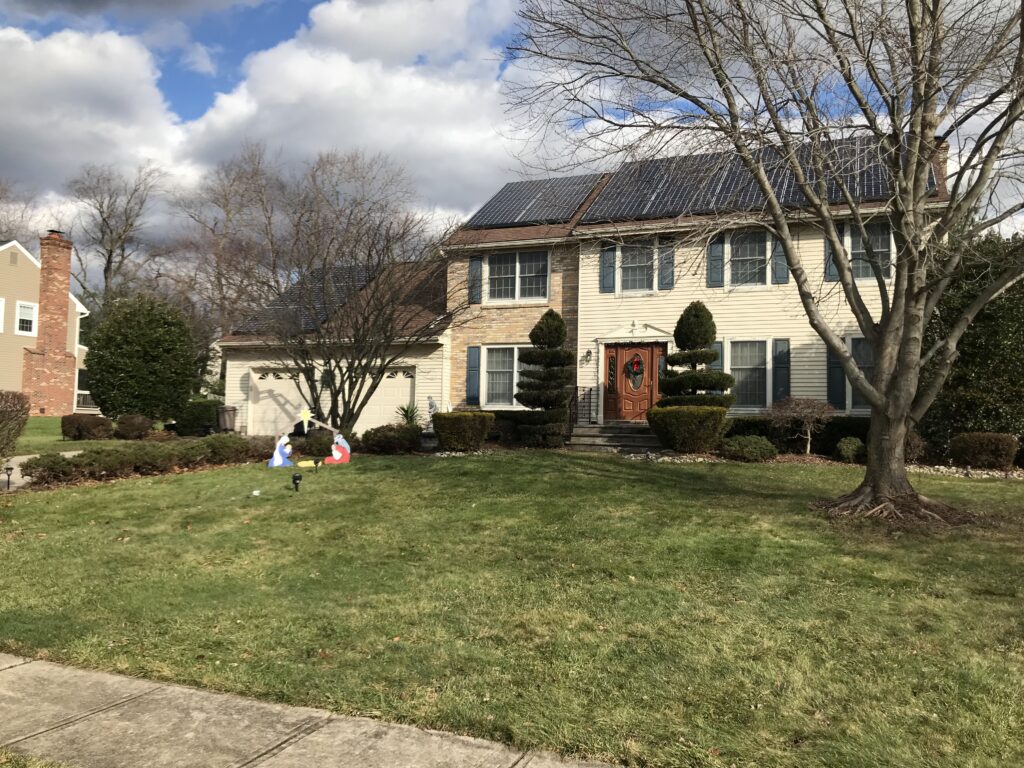
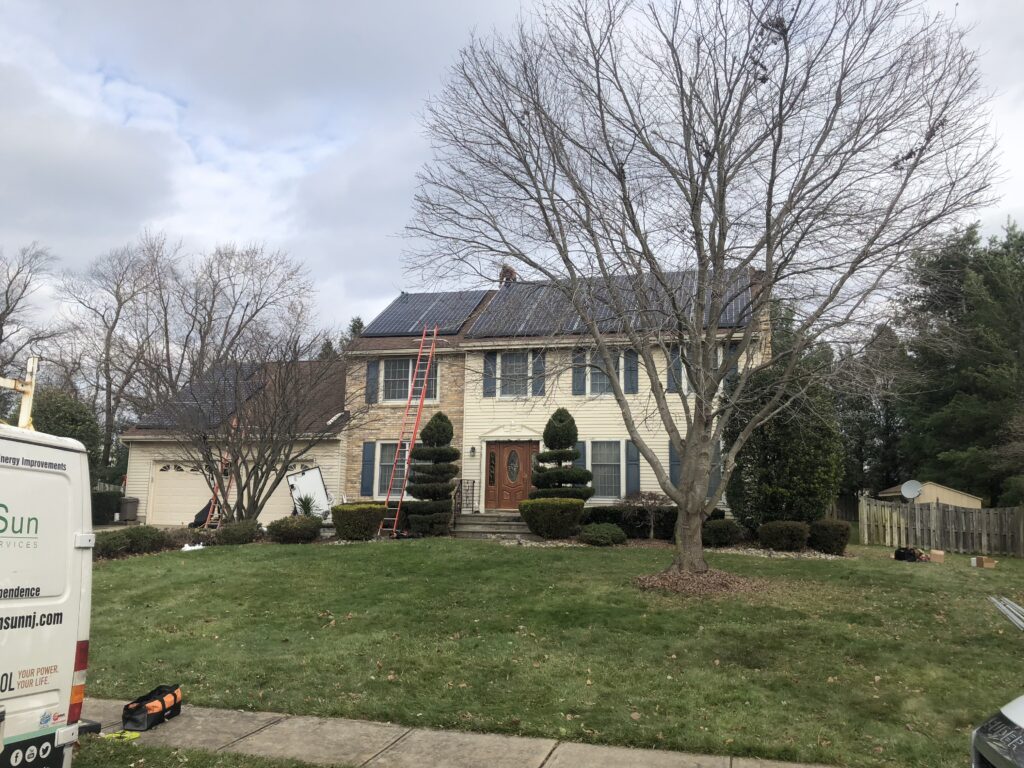
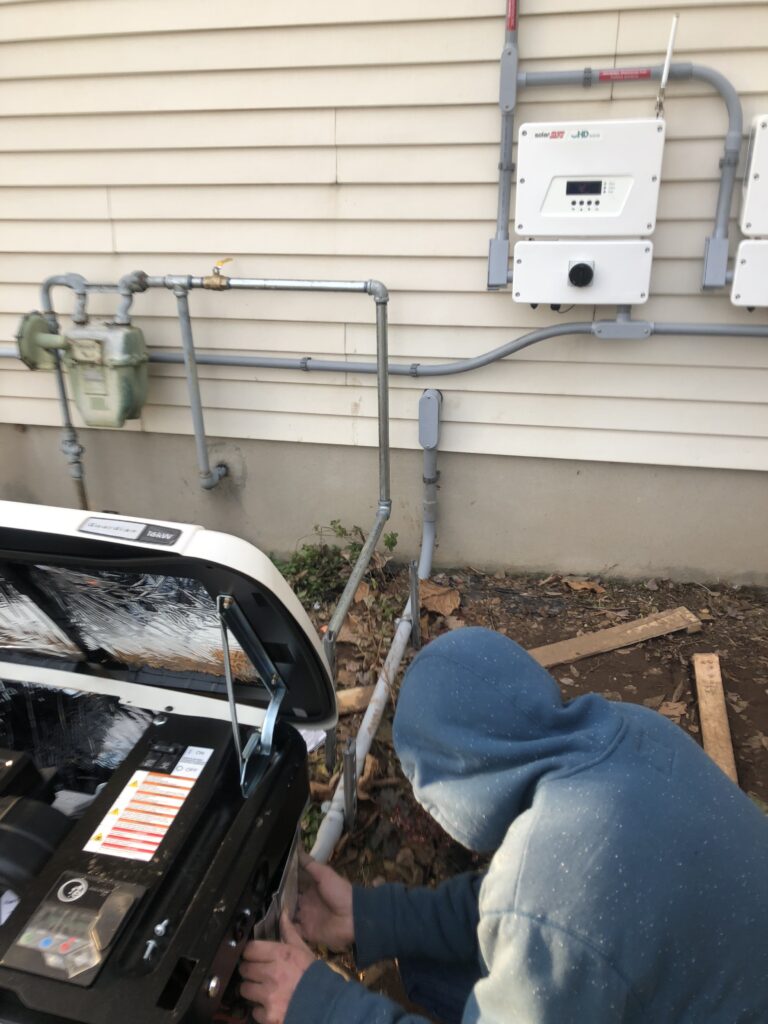
46-panel 16.79 kW solar array in Monmouth Junction, NJ by Green Sun Energy Services.
Ashraf in Monmouth Junction has been a Green Sun Energy Services client since September of 2018. He signed for the solar array and the standby generator on the same day; the array was commissioned on 25 November and the generator eight days later.
16.79 kW, and why two inverters
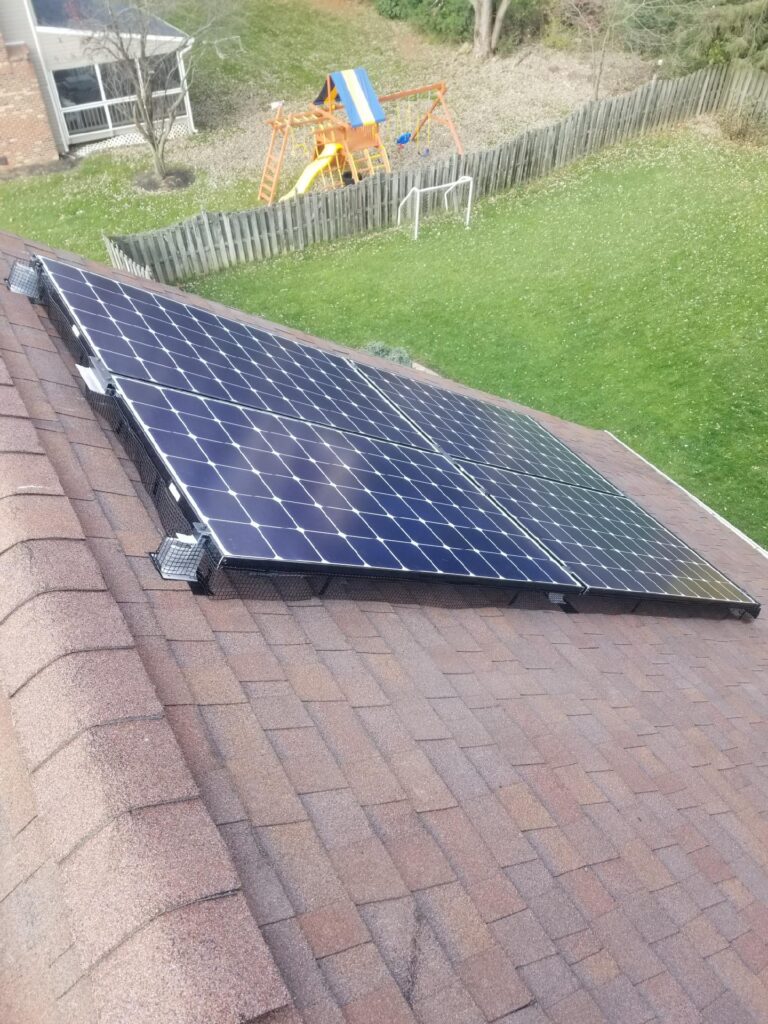
Forty-six LG 365-watt panels, 16.79 kW in total, on Ecolibrium mounting with an optimizer on every panel and 264 feet of critter guard around the perimeter. Estimated first-year production is 20,775 kWh and the utility is PSE&G.
The array runs on two SolarEdge SE6000H inverters rather than one, and the reason is simply arithmetic: no single residential inverter in that family takes 16.79 kW. Pairing two is the ordinary answer, and it brings a second benefit that only shows up years later — an inverter is the component of a solar system most likely to need attention within the panels’ lifetime, and a house with two of them does not go to zero production while one is being dealt with.
A 16 kW generator eight days later
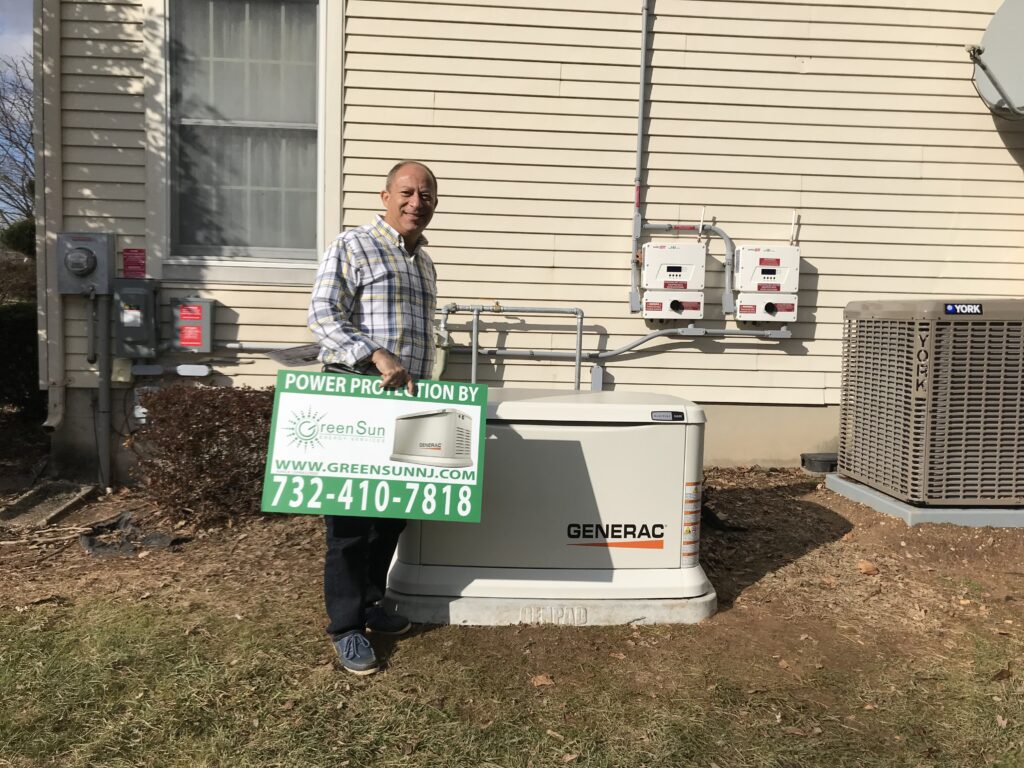
The machine is a Generac 16 kW, model 70371, rated 16 kW on natural gas and on propane alike, and this house runs on natural gas. It sits behind a 200-amp service-rated transfer switch mounted indoors in the basement beside the service panel.
The house is 3,500 square feet and its electrical calculation comes to 18,376 watts. Air conditioning is 4,000 of that and is managed while the generator runs, leaving 14,376 watts to carry — inside the machine’s rating, and clear of the 15 kW the code calculation sets as a minimum.
It is worth noticing that the array is larger than the generator: 16.79 kW of panels against a 16 kW machine. That is not an inconsistency. The array is sized against a year of consumption and the roof available to offset it; the generator is sized against the worst simultaneous demand the house can present. Those are different questions with different answers, and a house where they happen to land near each other is a coincidence rather than a design rule.
Built to be added to
A property with solar, a standby generator and rodent guard on the array is not three purchases. It is one piece of infrastructure assembled in stages, and the stages matter less than whether each one leaves room for the next.
That is the practical argument for having the same company hold all of it. The generator survey established what this house actually draws, appliance by appliance, before the array was designed. The array’s conduit and interconnection were planned knowing where the transfer switch would go. The guard went on with the panels rather than being retrofitted to a live array later, which is faster and less expensive because the crew and the roof access are already there.
Whatever gets added to a house like this next — a charger, a heat pump, storage — arrives at a service panel somebody already has a complete drawing of.
Why Monmouth Junction homeowners choose Green Sun Energy Services
More than solar panels: a professionally managed energy system, from design and permitting through installation, inspection, activation and ongoing support.
Complete backup power, from sizing and installation to the service that keeps it ready.
What makes Green Sun Energy Services different
- Solar: design and installation supervised by a NABCEP-certified professional (#PVA-111016-016148), with SolarEdge optimizers on every panel so each one reports its own output. On this home: a 16.79 kW solar array of 46 LG 365Q1C-A5/40mm panels, a SolarEdge SE6000H-US000NNC2 inverter, the Ecolibrium Solar mounting system and 264 ft of critter guard.
- Standby generators: installed and serviced as a Generac Authorized Sales and Service Dealer, by factory-authorized Generac technicians. On this home: a Generac 70371 standby generator (16 kW LP / 16 kW NG) running on natural gas, on a 200-amp transfer switch (managed whole house) and serviced by Green Sun Energy Services.
- Warranty: backed by a 15-year solar workmanship warranty and a 5-year generator workmanship warranty.
- Local: locally owned and operated in New Jersey since 2010, NJHIC licensed (#13VH06229000), with 48 completed solar projects and 36 completed standby generator projects across Middlesex County and 361 solar projects and 621 standby generator projects throughout New Jersey.
Our work in Monmouth Junction
Green Sun Energy Services has completed 1 featured solar project, 4 standby generator installations and 4 generator service customers in Monmouth Junction. Monmouth Junction, a community in South Brunswick Township, is served by PSE&G.
Generate electricity on your roof and use it to help power your vehicle.
Thinking about solar, a standby generator, or both for your Monmouth Junction home? Tell us about your project here or call 732-410-7818.
Power it. Protect it. Maintain it.
Project Facts
- Location
- Monmouth Junction, NJ
- Services
- Solar Critter Guard, Solar Panel Installation, Standby Generator Installation, Standby Generator Service
- Client since
- September 2018
Solar
- Manufacturer & model
- LG 365Q1C-A5/40mm
- Panels
- 46
- System size
- 16.79 kW
- Inverter
- SolarEdge SE6000H-US000NNC2
- Mounting system
- Ecolibrium Solar
- Estimated first-year production
- 20,775 kWh
- Share of the home's electricity
- 83%
- Electric utility
- PSE&G
- Critter guard fitted
- 264 ft
- Workmanship warranty
- 15 years
Standby generator
- Manufacturer & model
- Generac 70371
- Rated output
- 16 kW LP / 16 kW NG
- Fuel
- Natural Gas
- Home sized for
- 3,500 sq ft
- Electrical service
- 200 amp
- Transfer switch
- 200 amp
- Load management
- Managed Whole House
- Workmanship warranty
- 5 years
Questions from Monmouth Junction homeowners
Standby generatorHow is the gas pipe size worked out?
From the generator's demand, the available pressure, the pipe length, the allowable pressure drop, the fittings, the pipe material and every other appliance connected to the system. The adopted fuel-gas code carries the sizing requirements and tables, and the model's published fuel consumption goes into the calculation.
Standby generatorWhat does a whole-house generator actually mean?
Whole-house generally means the transfer equipment serves the home's main electrical system rather than a small emergency-circuit panel. It does not promise unlimited capacity. High-demand appliances may still be prioritized or briefly shed while generator capacity is being used elsewhere.
SolarCan the old mounting hardware be reused after a reroof?
It depends on the manufacturer's requirements, the condition of the components and the warranty. The roof penetrations and weatherproofing components matter most, and a reroof is often the moment to replace the attachment and flashing rather than reinstall ageing roof-interface hardware.
SolarWhich utility handles interconnection in Monmouth Junction?
The electric distribution company that serves the property. In New Jersey that is Jersey Central Power & Light, PSE&G, Atlantic City Electric or Rockland Electric depending on the address, and municipal electric systems can have their own requirements.
SolarWhich building code applies to rooftop solar?
For applicable one- and two-family dwellings New Jersey adopts the 2024 International Residential Code. Its solar provisions cover structural loads, rooftop systems, roof penetrations, fire classification, roof access and pathways.