

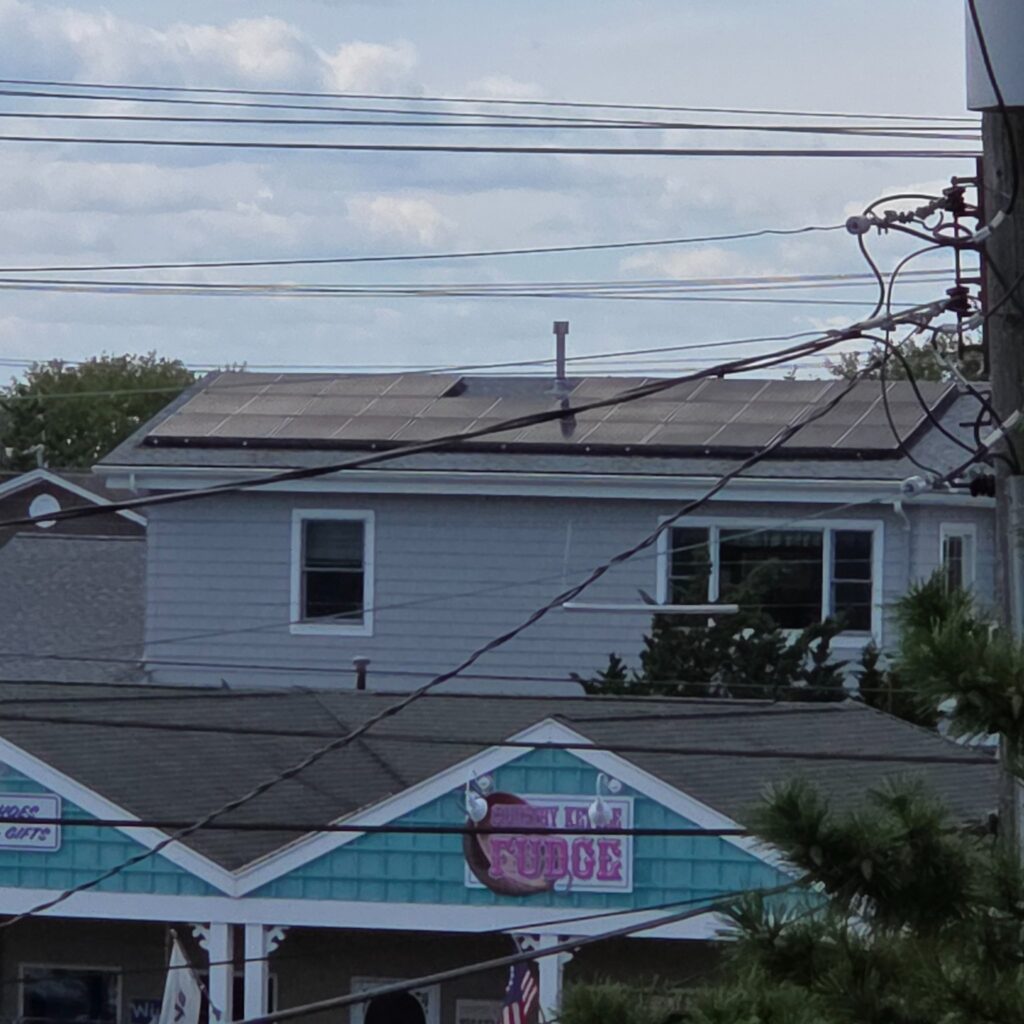
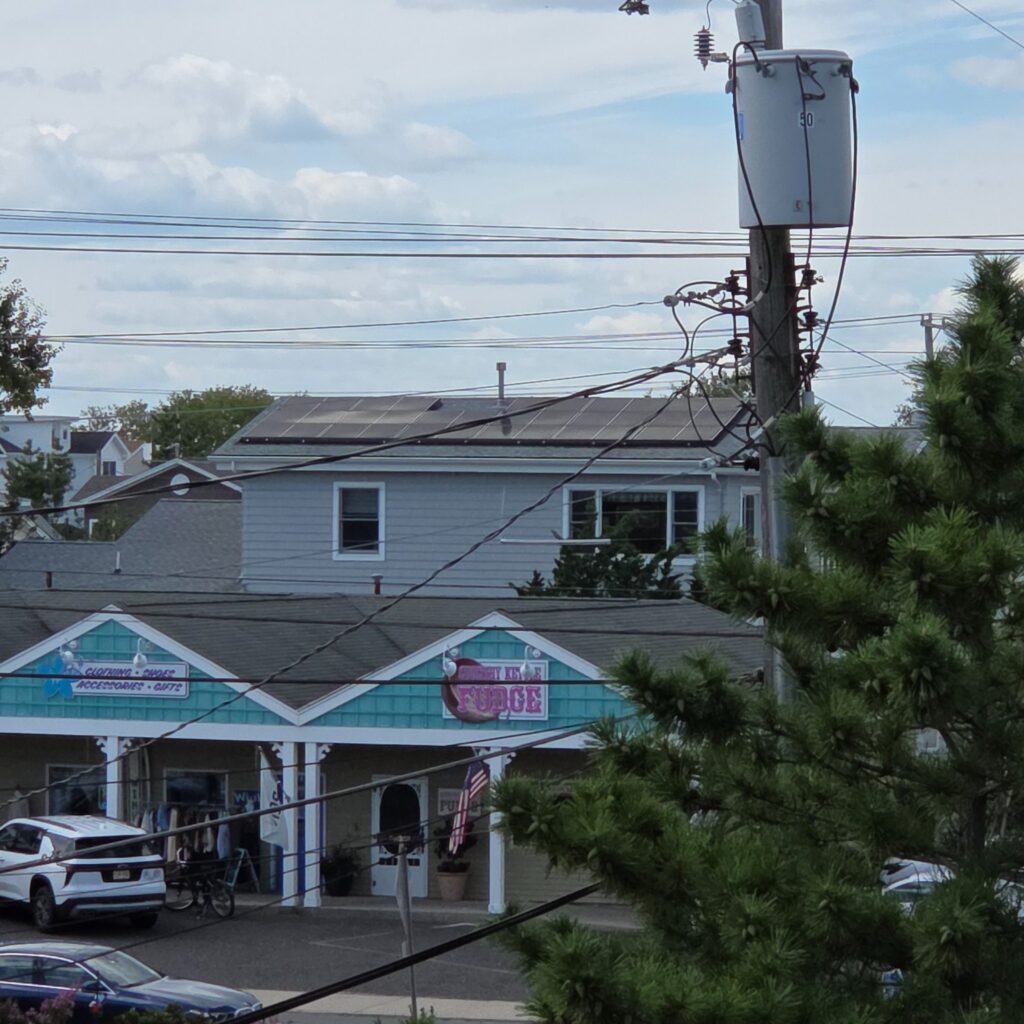
28-panel 8.96 kW solar array
Bob and Ila in Surf City have been Green Sun Energy Services clients since May of 2018. The solar array went up that July, and the standby generator already on the property came onto our books at the same time.28 panels and 184 feet of guard:
Twenty-eight Hanwha Q.
PEAK DUO 320-watt panels, 8.96 kW in total, in two groups — seventeen on the left roof face and eleven on the right — at a shallow 17-degree pitch, facing east-south-east with no measured shading at all. A SolarEdge SE7600H inverter with an optimizer on every panel, on Ecolibrium mounting. Estimated first-year production is 11,371 kWh and the utility is Atlantic City Electric. It was commissioned on 26 July 2018.
Fitted at the same time: 184 feet of critter guard around the perimeter of both arrays.
Doing that on day one rather than later is the entire point, and it is also less expensive. Guard fitted with the array is a few hours of work while the crew, the harnesses and the roof access are already on site and set up. Guard fitted afterwards is a separate visit: back up to a live array, working around panels that are already producing, and — if squirrels have got there first — repairing chewed DC wiring before anything else can happen. What makes the second version the harder job is not the mesh. It is everything around the mesh.
The generator, taken on in 2018
The standby machine is a Generac 22 kW from the 7000 series, model 7043, installed by another company. Its servicing came to us in May 2018 on a PowerBase Silver plan, and it was last serviced on 8 June 2026.
Two systems, two jobs, one number to call
The array and the generator on this property answer different questions and always will. The panels reduce what the household buys from the grid across a year and contribute precisely nothing during an outage — a grid-tied system disconnects the moment utility power fails, and has to, so that it cannot feed a line a crew is working on. The generator does the reverse: nothing for the annual bill, everything for the days without supply.
What they have in common is that both are long-lived equipment on a roof and beside a house, in salt air, and both will still be there in twenty years. Equipment like that does not fail dramatically. It degrades quietly, and the failure is discovered at the worst moment unless somebody is looking at it on a schedule.
On this property the array got its guard on the day it went up and the generator got a service plan the same month. That is the same decision made twice.
Why Surf City homeowners choose Green Sun Energy Services
More than solar panels: a professionally managed energy system, from design and permitting through installation, inspection, activation and ongoing support.
We keep your generator ready before the power goes out.
What makes Green Sun Energy Services different
- Solar: design and installation supervised by a NABCEP-certified professional (#PVA-111016-016148), with SolarEdge optimizers on every panel so each one reports its own output. On this home: an 8.96 kW solar array of 28 Hanwha Q.PEAK DUO-G5.320 panels, a SolarEdge SE7600H-US000NNC2 inverter, the Ecolibrium Solar mounting system and 184 ft of critter guard.
- Standby generators: installed and serviced as a Generac Authorized Sales and Service Dealer, by factory-authorized Generac technicians. On this home: a standby generator serviced by Green Sun Energy Services.
- Warranty: backed by a 15-year solar workmanship warranty.
- Local: locally owned and operated in New Jersey since 2010, NJHIC licensed (#13VH06229000), with 48 completed solar projects and 60 completed generator service projects across Ocean County and 361 solar projects and 936 generator service projects throughout New Jersey.
Our work in Surf City
Surf City, a borough on Long Beach Island in Ocean County, is served by Atlantic City Electric.
Generate electricity on your roof and use it to help power your vehicle.
Thinking about solar, generator service, or both for your Surf City home? Tell us about your project here or call 732-410-7818.
Power it. Protect it. Maintain it.
Project Facts
- Location
- Surf City, NJ
- Services
- Solar Critter Guard, Solar Panel Installation, Standby Generator Service
- Client since
- May 2018
Solar
- Manufacturer & model
- Hanwha Q.PEAK DUO-G5.320
- Panels
- 28
- System size
- 8.96 kW
- Inverter
- SolarEdge SE7600H-US000NNC2
- Mounting system
- Ecolibrium Solar
- Estimated first-year production
- 11,371 kWh
- Share of the home's electricity
- 95%
- Electric utility
- Atlantic City Electric
- Critter guard fitted
- 184 ft
- Workmanship warranty
- 15 years
Standby generator
- Manufacturer & model
- Generac 7043
- Rated output
- 22 kW LP / 19.5 kW NG
- Fuel
- Natural Gas
- Electrical service
- 200 amp
- Transfer switch
- 100 amp
- Load management
- Dedicated (Essential) Circuits
Questions from Surf City homeowners
Standby generatorCan a generator sit on compacted stone?
Certain air-cooled models can, on a properly prepared compacted aggregate base, where the applicable installation manual permits it. The base has to be stable, level, and resistant to settling and erosion, and the preparation comes from the model's own manual rather than from general practice.
Standby generatorWhat is the main line circuit breaker on a generator?
It is the generator's primary AC output breaker. Worth knowing because if it is open the engine can run without delivering any power through the transfer system -- a machine that sounds like it is working while the house stays dark.
Standby generatorCan the generator stay connected during a pressure test?
The machine has to be protected from test pressures beyond what its fuel controls are built to withstand. The fuel-gas code sets out when appliances are disconnected or isolated for testing, and the plumbing contractor follows both that code and the generator's installation instructions.
SolarWhat does solar offset mean?
It compares the array's estimated annual production with the home's expected annual consumption. A house using 12,000 kWh a year with a system expected to generate 11,400 kWh has a 95 percent offset. It is an annual energy comparison, not a promise that solar supplies 95 percent of the electricity in any given hour.
SolarWhat is hosting capacity, and can it affect a Surf City property?
Hosting capacity is how much distributed generation a part of the grid can take without affecting safety or reliability. A neighborhood with a lot of existing solar can face interconnection limits even where the individual property is ideal for it -- which is why the utility review is not a formality.