

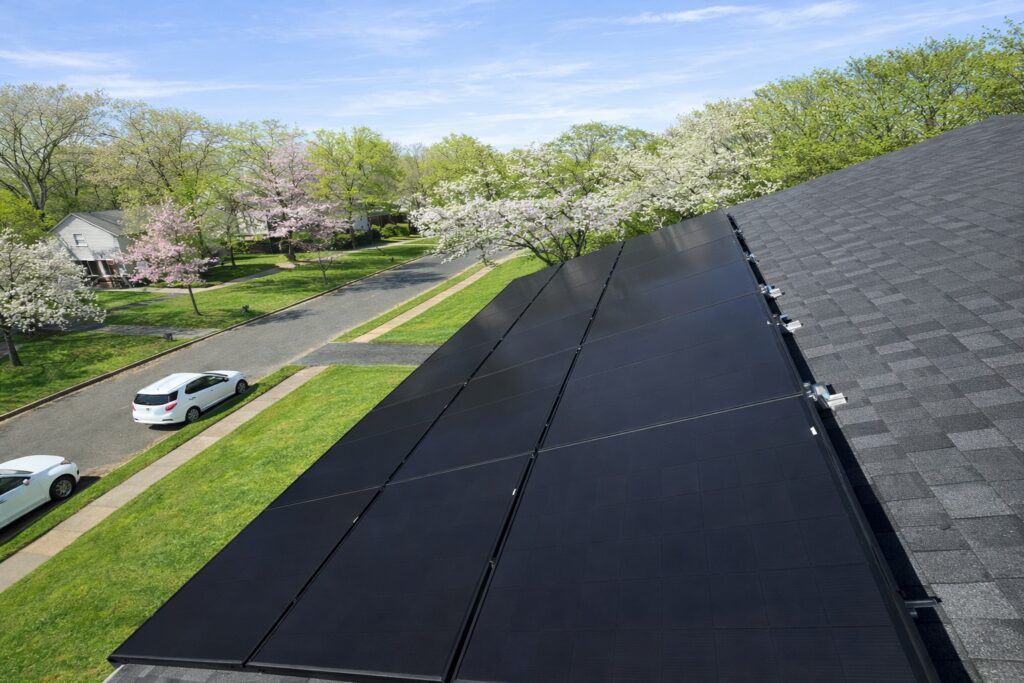
Wilson from East Brunswick, NJ has been a Green Sun Energy Services client since September of 2024. The array was completed in November: 36 panels making 16.56 kW into a SolarEdge Energy Hub inverter with optimizers, both carrying 25-year warranties, and an estimated 18,256 kilowatt hours in the first year. PSEG interconnected the system in January of 2025. At over sixteen kilowatts this is among the larger residential arrays we have built, and the Energy Hub inverter is the version designed to take battery storage later – so the option stays open without the electrical work having to be redone. The household had its own roofer for the roof, so our work stayed with the array.
Why Wilson chose Green Sun Energy Services
More than solar panels: a professionally managed energy system, from design and permitting through installation, inspection, activation and ongoing support.
What makes Green Sun Energy Services different
- Solar: design and installation supervised by a NABCEP-certified professional (#PVA-111016-016148), with SolarEdge optimizers on every panel so each one reports its own output. On this home: a 16.56 kW solar array of 36 REC 460AA-PURE-RX-DC panels, a SolarEdge SE11400H-USSNBBL14 HD Wave Energy Hub inverter and the Snap-N-Rack mounting system.
- Warranty: backed by a 10-year solar workmanship warranty.
- Local: locally owned and operated in New Jersey since 2010, NJHIC licensed (#13VH06229000), with 48 completed solar projects across Middlesex County and 360 solar projects throughout New Jersey.
Our work in East Brunswick
Green Sun Energy Services has completed 10 featured solar projects in East Brunswick. East Brunswick, a township in Middlesex County, is served partly by JCP&L and partly by PSE&G.
Generate electricity on your roof and use it to help power your vehicle.
Thinking about solar for your East Brunswick home? Tell us about your project here or call 732-410-7818.
Power it. Protect it. Maintain it.
Project Facts
- Location
- East Brunswick, NJ
- Service
- Solar Panel Installation
- Client since
- September 2024
- Manufacturer & model
- REC 460AA-PURE-RX-DC
- Panels
- 36
- System size
- 16.56 kW
- Inverter
- SolarEdge SE11400H-USSNBBL14 HD Wave Energy Hub
- Mounting system
- Snap-N-Rack
- Estimated first-year production
- 18,256 kWh
- Share of the home's electricity
- 100%
- Electric utility
- PSE&G
- Workmanship warranty
- 10 years
Solar questions from East Brunswick homeowners
What is an SREC-II?
A New Jersey solar renewable-energy certificate created for qualifying projects under the Successor Solar Incentive programme. A qualifying system earns one SREC-II for each megawatt-hour -- a thousand kilowatt-hours -- of eligible solar electricity it generates.
How much does shade from mature East Brunswick trees affect production?
Shade can materially reduce production, particularly when it falls during the highest-production hours. Module-level electronics such as microinverters and optimizers reduce the effect of partial shading, but they cannot create sunlight where there is none. Significant shade should be modelled before any annual production figure is quoted.
Is the roof strong enough to carry solar?
It has to be verified as part of the design rather than assumed. The residential code requires the roof structure to support the loads the array imposes in addition to snow, wind and the rest. The evaluation looks at rafter or truss size, span, spacing, roof material, system weight, snow and wind loads, and where the attachments land.