

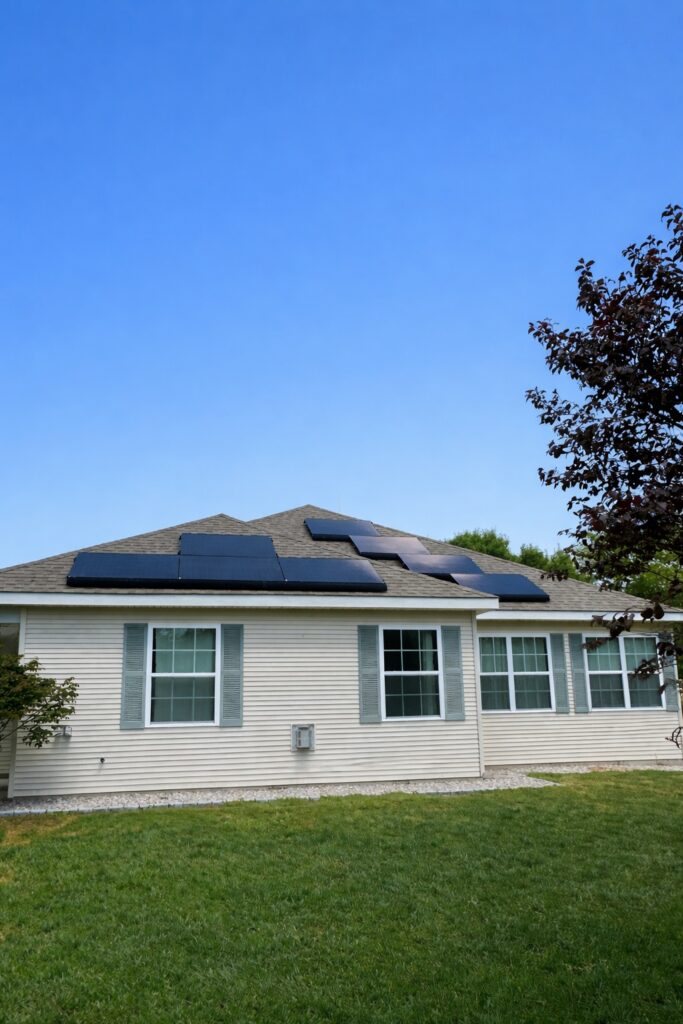
Charles and Julie from Little Egg Harbor, NJ have been Green Sun Energy Services clients since July of 2025 at this address – and they are not new to us, having leased an array through Green Sun at another property back in 2012. Coming back thirteen years later, for a second house, is the part of this record worth stating plainly. The array was completed in August of 2025: 12 panels making 5.1 kW, each with its own Enphase IQ8 microinverter carrying a 25-year warranty, and an estimated 7,161 kilowatt hours in the first year against what Atlantic City Electric supplies. It is leased rather than owned, and the lease price is fixed rather than rising each year. The existing roof was sound enough to build on, so the work stayed with the array.
Why Charles and Julie chose Green Sun Energy Services
More than solar panels: a professionally managed energy system, from design and permitting through installation, inspection, activation and ongoing support.
What makes Green Sun Energy Services different
- Solar: design and installation supervised by a NABCEP-certified professional (#PVA-111016-016148), with Enphase microinverters on every panel so each one reports its own output. On this home: a 5.1 kW solar array of 12 Jinko JKM425N-54HL4R-B panels, an EnPhase IQ8PLUS-72-2-US Micro-Single inverter and the Unirac mounting system.
- Warranty: backed by a 5-year solar workmanship warranty.
- Local: locally owned and operated in New Jersey since 2010, NJHIC licensed (#13VH06229000), with 48 completed solar projects across Ocean County and 361 solar projects throughout New Jersey.
Our work in Little Egg Harbor
Green Sun Energy Services has completed 8 featured solar projects in Little Egg Harbor. Little Egg Harbor, a township in Ocean County, is served by Atlantic City Electric.
Generate electricity on your roof and use it to help power your vehicle.
Thinking about solar for your Little Egg Harbor home? Tell us about your project here or call 732-410-7818.
Power it. Protect it. Maintain it.
Project Facts
- Location
- Little Egg Harbor, NJ
- Service
- Solar Panel Installation
- Client since
- July 2025
- Manufacturer & model
- Jinko JKM425N-54HL4R-B
- Panels
- 12
- System size
- 5.10 kW
- Inverter
- EnPhase IQ8PLUS-72-2-US Micro-Single
- Mounting system
- Unirac
- Estimated first-year production
- 7,161 kWh
- Share of the home's electricity
- 99%
- Electric utility
- Atlantic City Electric
- Workmanship warranty
- 5 years
Solar questions from Little Egg Harbor homeowners
What does NEC Article 690 cover?
It is the principal code article for photovoltaic systems, covering PV circuits, conductors, overcurrent protection, disconnects, wiring methods, grounding, labelling, rapid shutdown and equipment installation. New Jersey currently uses the 2023 edition.
Does the electric meter get changed?
The utility has to provide metering capable of properly measuring the electricity delivered to and received from a net-metered customer. Which meter that is, and how it gets swapped, varies by utility.
What should a Little Egg Harbor homeowner look for in a solar company?
One that can design, permit, interconnect, install, commission, monitor and service the system, and explain the structure accurately. That means twelve months of real usage, a realistic production model, correct kW and kWh arithmetic, orientation and shading, structural capacity, the rooftop code requirements, the electrical articles for photovoltaic systems and grid interconnection, rapid shutdown, manufacturer installation instructions, utility interconnection and net metering, incentive registration, roof age and condition, penetration and waterproofing detail, the panel, inverter, mounting and workmanship warranties, monitoring, and service after the installation. The question worth asking is not who quoted least, but which company has designed the best long-term system for the house and will still be able to support it years from now.