

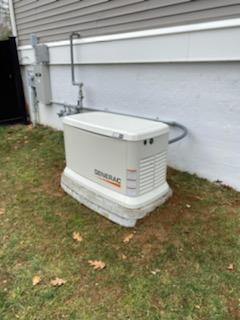
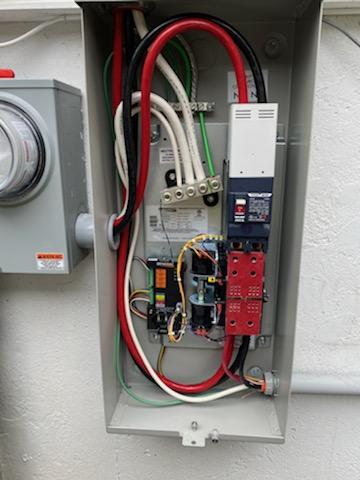
22 kW Generac standby generator in Manalapan, NJ by Green Sun Energy Services.
Wicker Tree Trust in Manalapan, NJ has been a Green Sun Energy Services client since May of 2021. The load survey came to 3,450 square feet, and the Generac commissioned in February of 2022 is rated 22 kW on propane and 19.5 kW on the natural gas it runs on here. A 200-amp automatic transfer switch backs the whole panel, so nothing has to be nominated in advance as essential and nothing is left off when the power goes. Remote monitoring is part of the service cover, and the one-year, two-year and three-year maintenance visits were completed between January of 2023 and December of 2024.
Why Manalapan homeowners choose Green Sun Energy Services
Complete backup power, from sizing and installation to the service that keeps it ready.
What makes Green Sun Energy Services different
- Standby generators: installed and serviced as a Generac Authorized Sales and Service Dealer, by factory-authorized Generac technicians. On this home: a Generac 7043-2 standby generator (22 kW LP / 19.5 kW NG) running on natural gas, on a 200-amp transfer switch (managed whole house) and serviced by Green Sun Energy Services.
- Warranty: backed by a 5-year generator workmanship warranty.
- Local: locally owned and operated in New Jersey since 2010, NJHIC licensed (#13VH06229000), with 444 completed standby generator projects across Monmouth County and 621 standby generator projects throughout New Jersey.
Our work in Manalapan
Green Sun Energy Services has completed 11 standby generator installations and 14 generator service customers in Manalapan. Manalapan, a township in Monmouth County, is served by JCP&L.
Thinking about a standby generator for your Manalapan home? Tell us about your project here or call 732-410-7818.
Power it. Protect it. Maintain it.
Project Facts
- Location
- Manalapan, NJ
- Services
- Standby Generator Installation, Standby Generator Service
- Client since
- May 2021
- Manufacturer & model
- Generac 7043-2
- Rated output
- 22 kW LP / 19.5 kW NG
- Fuel
- Natural Gas
- Home sized for
- 3,450 sq ft
- Electrical service
- 200 amp
- Transfer switch
- 200 amp
- Load management
- Managed Whole House
- Workmanship warranty
- 5 years
Standby generator questions from Manalapan homeowners
What is a standby generator?
A permanently installed automatic backup-power system that supplies electricity to the house when utility power is unavailable. Unlike a portable, it is permanently connected to the home's electrical system through transfer equipment and normally runs on natural gas or liquid propane. When the power fails it starts on its own, carries the connected loads, and hands the house back to the utility once service returns.
Does a generator produce less on natural gas than on propane?
Some models do have a lower rated maximum output on natural gas than on propane -- a current 22 kW machine is rated 22 kW on LP and 21 kW on natural gas. Other models carry their own ratings, so the model-specific specification sheet is what settles it rather than a general rule.
Can Manalapan require a generator to sit farther from the house than the manufacturer does?
Yes. Another applicable requirement can result in greater separation than the manufacturer's listed minimum -- equipment may be permitted eighteen inches from a qualifying wall while the local ordinance requires several feet from a property line. Both requirements have to be satisfied; neither cancels the other.