

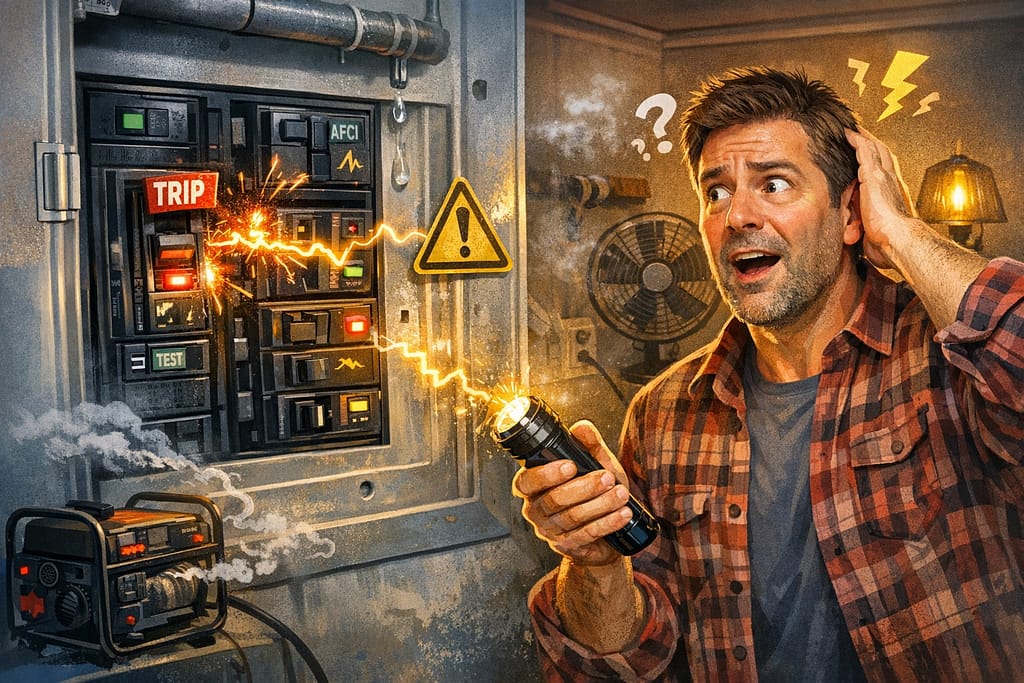
Why Do My New Electrical Service Breakers Trip So Often?
Executive Summary
If your new electrical breakers keep tripping, it doesn’t always mean something is wrong. Modern breakers—especially GFCI and AFCI types—are designed to be very sensitive to protect your home from shock and fire hazards.
Sometimes, they trip even when there’s no real danger. This is called a nuisance trip.
Common reasons include:
-
Sensitive electronics detecting small electrical changes
-
Appliances like vacuums or LED lights creating electrical noise
-
Generator power producing an “imperfect” electrical signal
-
Moisture or long wiring runs
The good news? These issues are very common, and in most cases, they can be corrected by a qualified electrician with proper adjustments or upgrades.
What Is a Nuisance Trip?
A nuisance trip (or false trip) happens when a breaker shuts off power even though there is no real electrical problem like:
-
Overload
-
Short circuit
-
Ground fault
-
Arc fault
Modern breakers use advanced electronics to monitor electricity in real time—and sometimes they’re a little too good at their job.
1. Why GFCI Breakers Trip (Even When Nothing Is Wrong)
A GFCI (Ground Fault Circuit Interrupter) monitors electricity flowing in and out of a circuit.
If it detects even a tiny difference (about 4–6 milliamps), it assumes electricity may be leaking somewhere unsafe—and trips.
Common Causes of GFCI Nuisance Trips
-
Small leakage from electronics (totally normal)
-
Long wiring runs in larger homes
-
Multiple plugged-in devices with filters
-
Moisture in outdoor or basement circuits
-
Electrical capacitance in wiring
-
Slight waveform irregularities
👉 In many cases, nothing is actually “broken”—the breaker is just being extra cautious.
2. Why AFCI Breakers Trip Frequently
An AFCI (Arc Fault Circuit Interrupter) looks for dangerous electrical arcs that could start fires.
It analyzes:
-
Waveform patterns
-
Electrical noise
-
Frequency spikes
Common Causes of AFCI Nuisance Trips
-
Vacuum cleaners
-
LED lighting and drivers
-
Motors (fridges, HVAC, tools)
-
Older appliances
-
Switching power supplies (chargers, TVs)
-
Generators or inverters
These devices can create electrical “noise” that looks like a dangerous arc—even when it’s not.
3. Why Breakers Trip During Power Outages or Generator Use
This is one of the most common complaints homeowners have.
When switching from utility power to a generator, several things change:
1. Waveform Distortion
Generators don’t always produce a perfectly smooth sine wave like utility power.
2. Neutral-Ground Bonding Differences
Small differences can create harmless leakage currents that trip GFCIs.
3. Voltage & Frequency Fluctuations
During startup, generators may not hold steady at:
-
120 volts
-
60 Hz
4. Harmonics (Especially with Inverter Generators)
These can confuse AFCI breakers into thinking there’s an arc fault.
4. Why This Happens More With New Electrical Panels
If you recently upgraded your electrical service, you’re not imagining things.
Modern code (NEC) requires:
-
AFCI protection
-
GFCI protection
-
Combination breakers
These breakers:
-
Use microelectronics
-
Have tighter trip thresholds
-
Are designed for maximum safety
👉 Result: More protection… but also more nuisance trips.
5. Common Solutions Electricians Use
The good news—this is fixable.
Typical Solutions Include:
-
Updating breakers if a manufacturer releases revised models
-
Separating circuits with heavy electronic loads
-
Replacing problematic appliances
-
Installing whole-home surge protection
-
Checking neutral and ground connections
-
Adjusting generator setup or transfer switch
-
Using generator-compatible breakers when needed
⚠️ Important: Never replace a breaker with a less-protective type just to stop tripping. That can create serious safety risks.
Top 10 Questions & Answers
1. Is it dangerous if my breaker keeps tripping?
Not necessarily. It often means the breaker is doing its job—but frequent trips should still be evaluated.
2. Why didn’t my old breakers trip like this?
Older breakers were less sensitive and didn’t detect modern electrical issues.
3. Can appliances cause breakers to trip?
Yes—especially vacuums, LED lights, and anything with a motor or power supply.
4. Are AFCI breakers required?
Yes, in most areas per modern electrical code.
5. Can a generator cause breaker trips?
Absolutely. Generator power is a common trigger.
6. Should I replace the breaker myself?
No—this should always be handled by a licensed electrician.
7. Are nuisance trips common?
Very common with newer electrical systems.
8. Can moisture cause trips?
Yes, especially in outdoor or basement circuits.
9. Is there a way to reduce nuisance trips?
Yes—through proper circuit design and updated equipment.
10. Do I need an electrical inspection?
If trips are frequent or disruptive, it’s a smart move.