

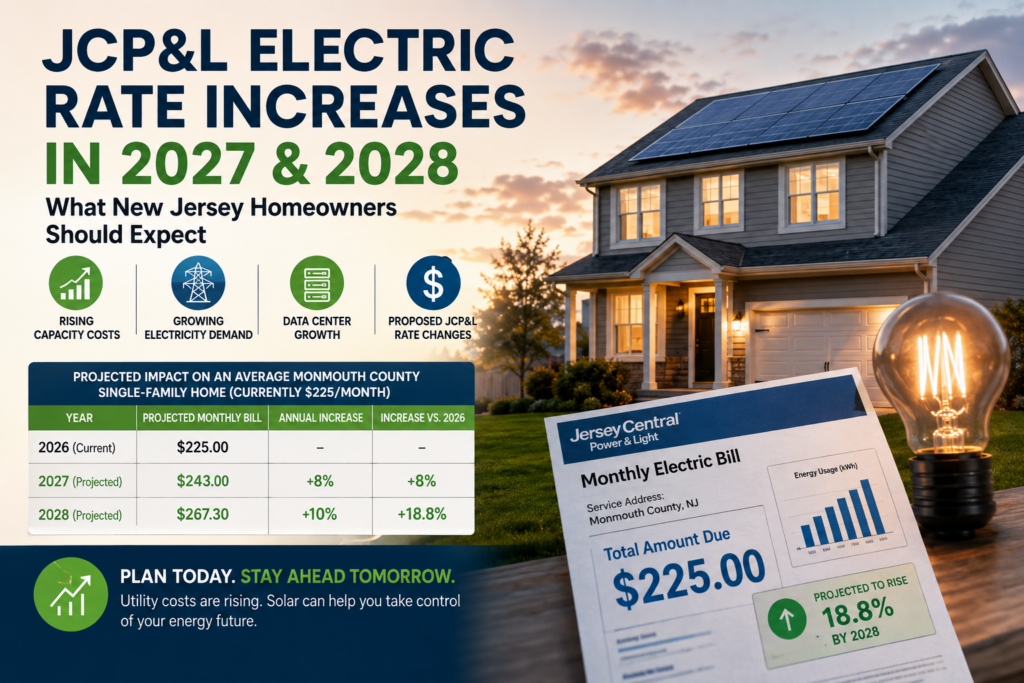
JCP&L Electric Rate Increases in 2027 and 2028: What New Jersey Homeowners Should Expect
Electricity costs have already risen sharply for New Jersey homeowners, and the latest information from the New Jersey Board of Public Utilities (NJBPU), PJM Interconnection and Jersey Central Power & Light (JCP&L) suggests that 2027 and 2028 could bring additional increases. Based on currently available information, Green Sun Energy Services believes homeowners should consider the possibility of approximately an 8% increase in 2027 followed by another 10% increase in 2028 when planning future household electricity expenses. These are planning projections—not approved future JCP&L rate increases.
For an average single-family home in Monmouth County currently spending approximately $225 per month on electricity, an 8% increase would raise the average bill to about $243 per month in 2027. Another 10% increase in 2028 would raise it to approximately $267 per month. That represents a combined increase of approximately 18.8% in two years, taking annual electricity expenses from about $2,700 today to more than $3,200 by 2028.
There are several reasons for that outlook. PJM capacity prices remain historically high, the NJBPU's August 2026 investigation says capacity-market clearing prices affecting New Jersey are expected to remain elevated through at least the 2028/2029 delivery year, and JCP&L has separately proposed new distribution and storm-recovery charges that could begin affecting residential customers in 2028.
Executive Summary: What Could Happen to JCP&L Bills in 2027 and 2028?
For planning purposes, Green Sun Energy Services is using the following scenario for an average Monmouth County single-family home currently paying approximately $225 per month for electricity:
| Year | Projected Monthly Bill | Projected Annual Bill | Annual Increase | Increase vs. 2026 |
|---|---|---|---|---|
| 2026 | $225.00 | $2,700 | Current baseline | — |
| 2027 | $243.00 | $2,916 | +8% | +8% |
| 2028 | $267.30 | $3,207.60 | +10% | +18.8% |
The Short Answer
A Monmouth County homeowner paying $225 per month today could potentially be paying approximately $267 per month by 2028—nearly 19% more for approximately the same amount of electricity.
The 8% and 10% figures above are Green Sun Energy Services planning projections and are not NJBPU-approved JCP&L rate increases. Actual future bills will depend on Basic Generation Service auctions, PJM energy and capacity costs, NJBPU decisions, JCP&L rate proceedings, electricity usage, taxes, riders, credits and other factors.
What makes 2027 and 2028 particularly important is that New Jersey homeowners face potential pressure from both sides of the electric bill: electricity supply costs and utility delivery costs.
Why Could JCP&L Electric Bills Increase in 2027 and 2028?
A JCP&L electric bill includes more than the electricity a homeowner consumes.
JCP&L maintains the local distribution system—the poles, wires, substations and other infrastructure that delivers electricity to customers.
Electricity supply for JCP&L customers who do not select a third-party supplier is obtained through New Jersey's Basic Generation Service (BGS) procurement process.
That means future bills can be affected by changes in wholesale electricity supply costs, PJM capacity costs, transmission charges, JCP&L distribution rates and other approved charges.
Going into 2027 and 2028, several of those components are under pressure.
What Is PJM Interconnection and What Does It Do?
Before discussing electricity prices, it's important to understand PJM Interconnection, because PJM plays a major role in how electricity is supplied and priced in New Jersey.
PJM Interconnection is the regional transmission organization, or RTO, that coordinates the movement of wholesale electricity across New Jersey and all or portions of 12 other states and Washington, D.C.
PJM is not JCP&L.
PJM does not send homeowners an electric bill, read their meters or maintain the local utility poles and wires running through their neighborhoods. Those are responsibilities of utilities such as JCP&L.
Instead, think of PJM as the organization responsible for coordinating the regional high-voltage electric grid and wholesale electricity markets that utilities and electricity suppliers throughout the region depend upon.
Among its responsibilities, PJM:
- Coordinates electricity across the regional high-voltage transmission grid.
- Operates wholesale electricity markets.
- Forecasts how much electricity customers throughout the region are expected to need.
- Works to ensure enough generating resources are available to maintain reliability.
- Operates a capacity market that pays qualifying resources to commit to being available when electricity is needed in the future.
- Coordinates long-term transmission planning as electricity demand and generation resources change.
Why Does PJM Matter to a JCP&L Customer?
New Jersey relies on PJM-administered wholesale markets for energy, capacity and other services.
Those wholesale costs can ultimately affect what New Jersey homeowners pay for electricity.
The NJBPU's August 2026 investigation explains that New Jersey relies on PJM-administered markets to procure capacity, energy and ancillary services and therefore New Jersey retail ratepayers are directly exposed to the outcomes of PJM's wholesale market design.
For homeowners, a simple way to think about it is:
JCP&L delivers electricity to your home.
PJM operates the regional grid and wholesale markets that help determine the cost and availability of electricity and generating capacity throughout the region.
New Jersey customers who don't choose a competitive third-party electric supplier generally receive default electricity supply through BGS. The NJBPU report explains that New Jersey's electric distribution companies procure that default generation supply from suppliers selected through the BGS auction under BPU oversight.
This is why developments occurring across the PJM region—such as a power plant retiring, delays in building new generation, rapid growth in electricity demand or the addition of large data centers—can eventually affect the electric bill of a homeowner in Monmouth County.
What Is the PJM Capacity Market?
The term “capacity” appears frequently in discussions about New Jersey's recent electricity-rate increases.
Capacity is different from the electricity a power plant actually produces.
A simple way to understand the difference is:
Energy = paying for electricity that is actually produced and consumed.
Capacity = paying to make sure enough generating capability will be available when the electric grid needs it.
PJM has to plan for periods when electricity demand is extremely high, such as a hot summer afternoon when millions of air conditioners are operating simultaneously.
It therefore needs enough generation and other qualifying resources committed to meet that potential demand—not just today's electricity demand.
Through its capacity market, PJM provides payments to qualifying resources that commit to being available during a future delivery year.
The NJBPU report explains that the central purpose of PJM's capacity market is to ensure reliability by procuring sufficient capacity to meet system demand. Capacity-market revenues are also intended to help retain existing resources and encourage development of new resources when additional capacity is needed.
Why Are Capacity Prices So Important Right Now?
Because those prices have increased dramatically.
The NJBPU notes that average New Jersey electric bills increased roughly 17% to 20% in 2025 compared with 2024, while PJM's Base Residual Auction capacity clearing prices increased approximately ninefold between the 2024/2025 and 2025/2026 delivery years.
Capacity has also become a much larger component of wholesale electricity costs.
According to the NJBPU investigation, capacity-market costs increased from approximately 6.5% of total wholesale power costs in 2024 to 15.8% in 2025.
That brings us directly to one of the biggest factors affecting our outlook for JCP&L electric rates in 2027 and 2028.
What Is Happening With PJM Capacity Prices?
PJM capacity prices have increased dramatically.
The NJBPU's August 2026 investigation shows PJM capacity-market clearing prices increasing from:
2024/2025: $28.92/MW-day
2025/2026: $269.92/MW-day
2026/2027: $329.17/MW-day
2027/2028: $333.44/MW-day
2028/2029: $325.00/MW-day
For New Jersey specifically, the change is equally significant.
The NJBPU report states that the New Jersey zonal capacity price increased from approximately $53.31/MW-day in 2024/2025 to $333.69/MW-day for 2027/2028.
That's more than a sixfold increase.
More importantly for homeowners trying to understand what comes next, the NJBPU report says capacity-market clearing prices are expected to remain elevated through at least the 2028/2029 delivery year.
Why Are Electricity Demand and Capacity Costs Increasing?
One of the biggest issues identified by PJM and the NJBPU is rapidly growing electricity demand.
The NJBPU report says PJM forecasts its summer peak demand to increase from approximately:
156 GW in 2026
to:
183 GW by 2030
222 GW by 2036
and:
253 GW by 2046.
At the same time, bringing new power plants and other generating resources online can take years.
The NJBPU investigation identifies permitting and siting issues, supply-chain constraints and investment uncertainty as some of the barriers preventing new generation from responding quickly to higher market prices.
In simple terms:
Electricity demand is growing quickly, while adding enough new electricity supply to meet that demand takes time.
When demand grows faster than available supply, prices can remain under pressure.
Are Data Centers Contributing to Higher Electricity Costs?
Data centers are receiving considerable attention because they can consume enormous amounts of electricity and are contributing to projected large-load growth across PJM.
The NJBPU's investigation found a particularly significant relationship between these large-load additions and capacity-market costs.
For the 2026/2027 PJM capacity auction, including large-load additions increased capacity-auction revenues by 82.1%, while increasing the amount of capacity actually procured by only 0.7%.
That doesn't mean data centers are solely responsible for rising New Jersey electric bills.
Electricity prices are affected by numerous factors.
However, the NJBPU's findings indicate that projected large-load growth is having a meaningful effect on PJM capacity-market costs.
What Do We Expect JCP&L Electric Bills to Do in 2027?
Based on the information currently available, Green Sun Energy Services is using an approximately 8% increase as a planning assumption for 2027.
That is not an announced or approved JCP&L rate increase.
The actual result will depend on New Jersey's BGS procurement, wholesale electricity and capacity prices, transmission costs, other approved charges and individual electricity consumption.
For our example Monmouth County homeowner currently averaging:
$225 per month
an 8% increase would bring the projected bill to:
$243 per month
or:
$2,916 per year.
That's approximately:
$18 more per month
and:
$216 more per year
for approximately the same amount of electricity.
Why Could 2028 Be More Significant for JCP&L Customers?
2028 deserves particular attention because potential wholesale electricity pressures could overlap with a separate JCP&L distribution rate proceeding.
In August 2026, JCP&L announced a new rate proposal involving additional distribution revenue and recovery of deferred storm costs.
According to JCP&L, the filing seeks approximately $253 million in additional base distribution revenue and recovery of approximately $476 million in previously deferred storm costs over 10 years.
JCP&L says that, if the proposal were approved as filed, the typical residential customer would eventually experience an approximately 8.8% total bill impact.
Importantly, this is a proposed increase—not an approved increase.
JCP&L's proposal remains subject to review by the NJBPU.
Read JCP&L's August 2026 rate proposal
Why Would JCP&L's Proposed Increase Affect 2028 Instead of 2027?
Timing is one of the most important aspects of JCP&L's proposal.
Although the proposed new base distribution rates could technically take effect during 2027, JCP&L has proposed using offsets intended to reduce or delay the residential impact.
Under JCP&L's proposal, those offsets would expire around the beginning of 2028, at approximately the same time its proposed storm-cost recovery charge would begin.
If approved substantially as proposed, 2028 could therefore combine:
Continued elevated wholesale electricity and capacity costs
with:
Additional JCP&L distribution and storm-recovery costs.
That's why we believe 2028 deserves even more attention than 2027.
Our Projected JCP&L Bill for 2028
For our hypothetical Monmouth County homeowner, we start with our projected 2027 bill of:
$243 per month
and apply our 10% planning assumption for 2028.
That produces:
$267.30 per month
or approximately:
$3,207.60 per year.
Compared with today's $225 monthly electric bill, that's:
$42.30 more per month
$507.60 more per year
and:
18.8% higher than today's bill.
Again, the 10% figure is a planning projection, not an approved JCP&L increase.
However, there is a reasonable basis for paying close attention to 2028: JCP&L itself has proposed an approximately 8.8% residential bill impact, if approved as filed, while the NJBPU expects wholesale capacity-market prices to remain elevated through at least the 2028/2029 delivery year.
Could JCP&L Electric Rates Increase Less Than Our Projection?
Yes.
One important factor limiting wholesale capacity costs is PJM's temporary capacity-market price collar.
The NJBPU report estimates that the price collar covering the 2026/2027 and 2027/2028 delivery years could save customers approximately $18 billion across PJM.
Its extension through the 2028/2029 and 2029/2030 delivery years is projected to save consumers another $27 billion.
Because New Jersey represents roughly 10% to 12% of PJM peak demand, the NJBPU estimates that New Jersey ratepayers could realize approximately $5 billion of those savings.
New Jersey regulators are also examining electricity affordability, resource adequacy and potential changes to the way electricity resources are procured.
Those efforts could help reduce some future cost pressure.
Could JCP&L Electric Rates Increase More Than Our Projection?
Yes.
The NJBPU report expects capacity-market prices to remain elevated through at least the 2028/2029 delivery year.
PJM is simultaneously confronting rapid projected electricity-demand growth and difficulty bringing sufficient new generating resources online quickly.
The NJBPU report also notes that recent PJM capacity auctions have procured less capacity than targeted under PJM's Installed Reserve Margin.
These conditions create uncertainty.
They don't mean homeowners should automatically expect annual increases of 15% or 20%.
But they also make it difficult to justify assuming utility electricity costs will simply remain flat.
What Would These Increases Mean for a Monmouth County Homeowner?
Here's the complete example:
2026 — Current Bill
Average Monthly Electric Bill: $225
Annual Electricity Expense: $2,700
2027 — Projected
Projected Increase: 8%
Projected Monthly Bill: $243
Projected Annual Electricity Expense: $2,916
2028 — Projected
Projected Increase: 10%
Projected Monthly Bill: $267.30
Projected Annual Electricity Expense: $3,207.60
By 2028, this homeowner could therefore be spending approximately:
$42 more every month
$508 more every year
and:
18.8% more than today
for approximately the same amount of electricity.
And this example assumes the homeowner's electricity consumption doesn't increase.
Homes adding an electric vehicle, heat pump, electric water heater, pool, hot tub or other significant electrical loads could see total electricity expenses increase faster because they would be purchasing more electricity at potentially higher rates.
What Does This Mean for New Jersey Homeowners Considering Solar?
Solar can't control what JCP&L, PJM or the wholesale electricity market charges.
What solar can do is reduce the amount of electricity a homeowner needs to purchase from the utility.
That distinction becomes increasingly important when electricity prices rise.
A homeowner currently paying $225 per month shouldn't necessarily evaluate solar economics under the assumption that the same electricity will still cost $225 per month 10, 15 or 20 years from now.
A better question is:
How much could utility electricity cost over the years I expect to own my home?
Nobody knows exactly what JCP&L electricity will cost in 2035 or 2040.
Homeowners should be skeptical of anyone claiming they can predict future electricity prices with certainty.
But we don't need to predict electricity prices 20 years into the future to recognize the near-term issues.
We already know PJM capacity prices have increased dramatically.
We know the NJBPU expects elevated capacity-market prices to continue through at least 2028/2029.
We know electricity-demand forecasts are increasing rapidly.
And we know JCP&L has filed a proposal that could add additional distribution and storm-recovery costs beginning in 2028 if approved.
For homeowners evaluating solar, those are meaningful factors when comparing the long-term cost of producing a portion of their electricity at home with continuing to purchase virtually all of it from the utility.
Frequently Asked Questions About JCP&L Electric Rates in 2027 and 2028
What is PJM Interconnection?
PJM Interconnection is the regional transmission organization that coordinates the wholesale electric grid serving New Jersey and all or portions of 12 other states and Washington, D.C.
PJM operates wholesale electricity markets, coordinates the movement of electricity across the high-voltage transmission system, forecasts electricity demand and works to ensure sufficient resources are available to maintain grid reliability.
PJM is not the same company as JCP&L.
What is the difference between PJM and JCP&L?
PJM manages the regional wholesale electricity grid and markets. JCP&L is the local electric distribution utility serving its customers.
JCP&L maintains the local poles, wires, substations and other distribution equipment that delivers electricity to homes.
PJM coordinates the larger regional grid and wholesale markets that help determine the cost and availability of electricity and generating capacity.
What is the PJM capacity market?
PJM's capacity market is designed to ensure enough electricity-generating capability and other qualifying resources will be available to meet future demand.
Capacity is different from energy.
Energy is the electricity actually generated and consumed. Capacity is a commitment to have generating capability available when the grid needs it.
Why do PJM capacity prices affect my JCP&L electric bill?
New Jersey electricity suppliers obtain energy, capacity and other services through wholesale markets. The costs associated with those purchases can ultimately be recovered through retail electricity prices.
The NJBPU notes that New Jersey retail customers are directly exposed to outcomes in PJM's wholesale markets.
Is JCP&L definitely raising electric rates 8% in 2027?
No.
The 8% figure is Green Sun Energy Services' planning projection, not an approved JCP&L rate increase.
Actual 2027 bills will depend on BGS procurement results, PJM wholesale electricity and capacity costs, NJBPU decisions, JCP&L charges and individual electricity consumption.
Is JCP&L definitely raising electric rates 10% in 2028?
No.
The 10% figure is also a Green Sun Energy Services planning projection.
However, 2028 deserves particular attention because JCP&L has filed a separate proposal that could result in an approximately 8.8% impact on the typical residential bill if approved substantially as proposed, while PJM capacity-market costs are expected to remain elevated.
How much could a $225 JCP&L electric bill increase by 2028?
Using our planning assumptions, a $225 monthly bill would increase to approximately:
$243 per month in 2027
and:
$267.30 per month in 2028.
That's an approximately 18.8% cumulative increase from the 2026 baseline.
Why are New Jersey electric rates increasing?
There isn't one single cause.
Important factors include wholesale energy costs, PJM capacity prices, rapid growth in projected electricity demand, transmission and distribution investments, infrastructure costs, storm-related expenses and difficulty bringing sufficient new generating resources online quickly.
Are data centers causing New Jersey electricity prices to increase?
Data centers are one contributor to rapidly growing projected electricity demand across PJM.
The NJBPU found that large-load additions had a disproportionately large impact on recent capacity-market costs. For the 2026/2027 auction, including large-load additions increased auction revenue by 82.1% while increasing cleared capacity by only 0.7%.
However, data centers are not the only factor affecting New Jersey electricity prices.
Could NJBPU reduce JCP&L's proposed rate increase?
Yes.
A utility rate filing is a request, not an automatic rate increase.
The NJBPU reviews utility rate filings and can determine what costs and rates ultimately may be recovered from customers.
Why could 2028 be more important than 2027?
2028 could potentially combine two separate sources of cost pressure:
Elevated PJM wholesale electricity and capacity costs
plus:
Potential JCP&L distribution and storm-recovery charges.
That's why our current planning scenario uses a larger increase for 2028 than for 2027.
Will every Monmouth County homeowner pay $267 per month in 2028?
No.
The $267 figure is an illustrative example based on a homeowner currently spending an average of $225 per month and our projected percentage increases.
Actual bills will depend on electricity consumption, future utility rates, rate class, taxes, riders, credits and other factors.
Will JCP&L electricity rates continue increasing after 2028?
Nobody can reliably predict long-term utility rates.
Current information supports an expectation of elevated PJM capacity-market costs through at least the 2028/2029 delivery year. After that, electricity prices will depend on future demand, new generation, transmission development, regulations, fuel prices, market reforms and other factors.
Can Solar Protect a Homeowner From Future JCP&L Rate Increases?
Solar doesn't eliminate every component of a JCP&L bill, and most homeowners remain connected to the electric grid.
However, solar can reduce the amount of electricity that must be purchased from the utility.
When utility electricity prices increase, the electricity produced by a homeowner's solar system can become more valuable because it offsets electricity that otherwise would have been purchased at the higher utility rate.
Should I Install Solar Just Because JCP&L Rates May Increase?
No single projected utility-rate increase should determine whether solar makes financial sense.
Homeowners should consider their electricity consumption, roof conditions, solar-system cost, available incentives, expected production, financing terms, expected time in the home and the long-term cost of utility electricity.
The Bottom Line: What Should JCP&L Customers Expect in 2027 and 2028?
No one knows exactly what an individual JCP&L customer will pay in 2027 or 2028.
But current conditions deserve attention.
For an average Monmouth County single-family home currently spending approximately $225 per month, Green Sun Energy Services believes the following represents a reasonable planning scenario:
2027: approximately $243 per month — an 8% increase
2028: approximately $267 per month — another 10% increase
That represents an approximately 18.8% cumulative increase in two years.
These are projections—not guaranteed increases or NJBPU-approved future JCP&L rates.
The underlying conditions, however, are real: PJM capacity prices have risen dramatically, the NJBPU expects elevated capacity-market prices to continue through at least 2028/2029, projected electricity demand is growing rapidly, and JCP&L has a separate pending rate proposal that could begin materially affecting residential bills in 2028.
For New Jersey homeowners, 2027 and especially 2028 are shaping up to be important years for electricity costs.
About Green Sun Energy Services, LLC
Based in Middletown, NJ, Green Sun Energy Services, LLC is a NABCEP-certified solar installer serving homeowners throughout Monmouth County and surrounding New Jersey communities.
Since 2010, we've helped New Jersey homeowners evaluate solar based on their actual electricity consumption, available roof space, expected solar production, available incentives and long-term electricity costs.
Sources & Additional Information
New Jersey Board of Public Utilities — An Investigation of PJM's Capacity Market, August 2026
This NJBPU report examines PJM capacity prices, resource adequacy, electricity-demand growth, large-load additions and the potential effect of wholesale capacity-market conditions on New Jersey ratepayers.
New Jersey Board of Public Utilities — Basic Generation Service (BGS)
Information about New Jersey's Basic Generation Service procurement process:
https://www.nj.gov/bpu/about/divisions/energy/bgs.html
New Jersey Board of Public Utilities — Resource Adequacy Investigation
Information about New Jersey's investigation of resource adequacy and PJM's capacity market:
https://www.nj.gov/bpu/bpu/about/divisions/ferc/resourceadequacy.html
PJM Interconnection — Capacity Market
Information about PJM's capacity market and auction process:
https://www.pjm.com/markets-and-operations/rpm
PJM Interconnection — About PJM
Information explaining PJM's role in operating the regional electric grid and wholesale electricity markets:
https://www.pjm.com/about-pjm
Jersey Central Power & Light / FirstEnergy — August 2026 Rate Proposal
JCP&L's announcement regarding its proposed distribution-rate changes, storm-cost recovery and proposed timing of residential impacts:
https://investors.firstenergycorp.com/investor-materials/news-releases/news-details/2026/JCPL-Rate-Proposal-Delays-Bill-Impact-for-Residential-Customers-Until-2028-While-Supporting-Reliability-Investments/default.aspx
Important Disclaimer
The 2027 and 2028 electric-bill projections presented by Green Sun Energy Services, LLC are estimates for informational and planning purposes only. They are not approved JCP&L rates, guarantees of future electricity costs or representations that rates will increase by the percentages shown.
Actual future electric bills will depend on electricity consumption, future Basic Generation Service procurement results, PJM wholesale market conditions, NJBPU decisions, JCP&L rate proceedings, taxes, riders, credits and other factors.