

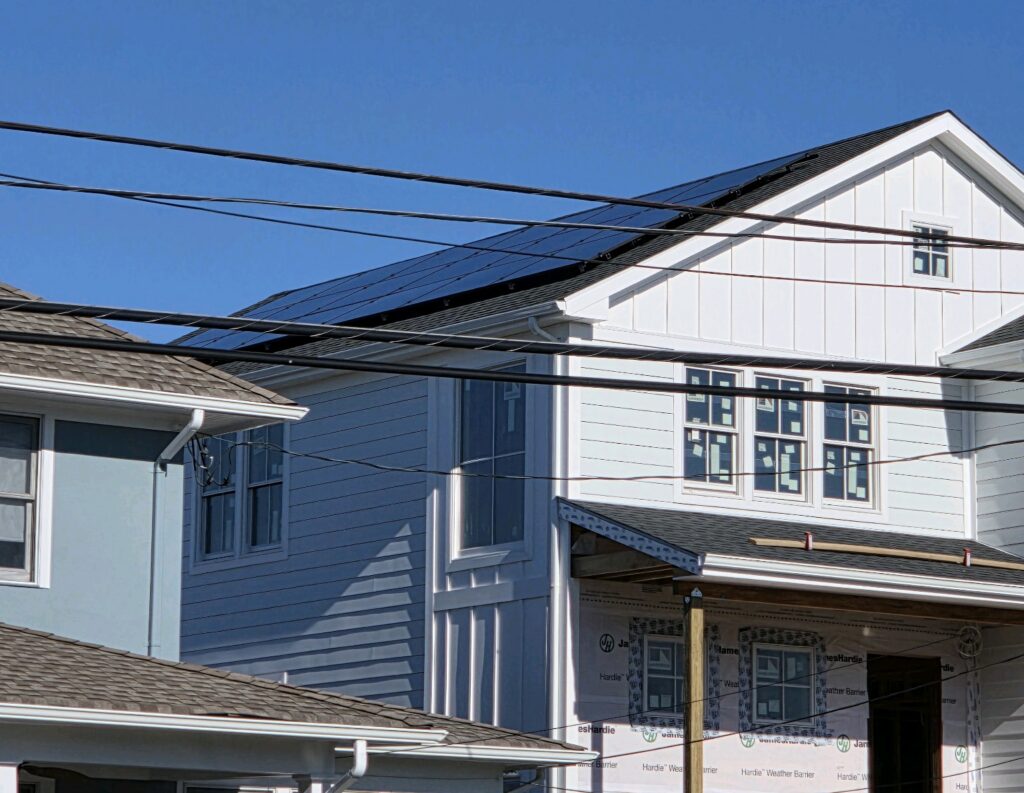
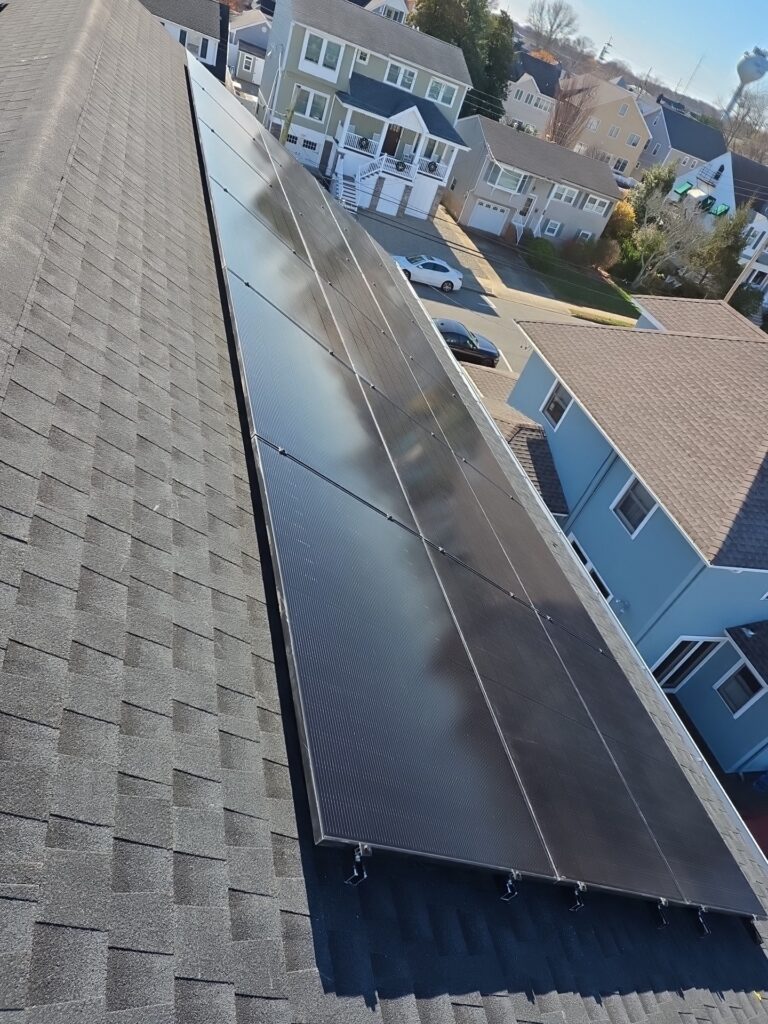
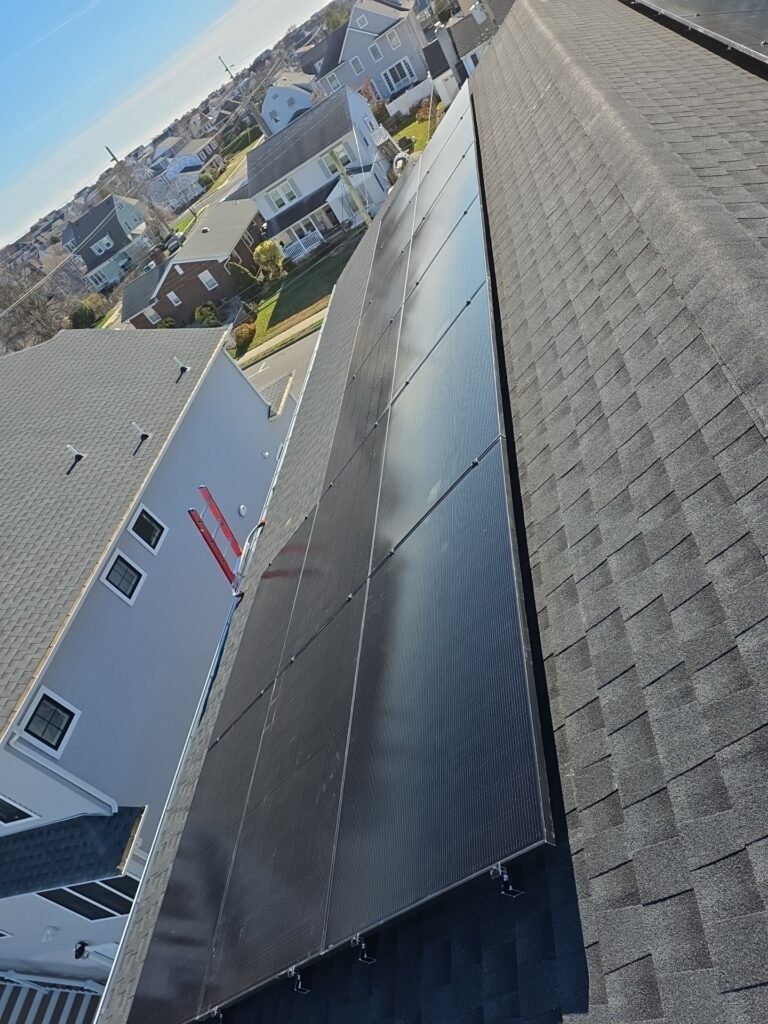
Solar Critter Guard and Solar Panel Installation in Point Pleasant Beach, NJ by Green Sun Energy Services.
Tanja from Point Pleasant Beach, NJ has been a Green Sun Energy Services client since September of 2025. Thirty-two JA Solar panels and a 14.08 kW array went onto the roof in a single day at the end of November, with an Enphase micro-inverter behind every panel. It is designed to produce an estimated 15,824 kWh a year — about 98% of the electricity this home uses, on JCP&L’s network.
Thirty-two panels, thirty-two inverters
The array is built from JA Solar JAM54D41 modules rated at 440 watts each, which is where the 14.08 kW comes from. They sit on a Unirac rail system fixed to the roof.
What is less usual is what sits behind them. Rather than running every panel down into one central inverter, each of the thirty-two panels has its own Enphase IQ8PLUS micro-inverter mounted directly beneath it. Every panel converts its own power and reports its own output, so a panel in shade, under a leaf, or simply facing a different way does not hold back the ones beside it. On a coastal roof, where a chimney shadow travels across a slope over the course of a morning, that is worth having — and it means the array can be read panel by panel rather than as one number at the wall.
98% of what the house uses
The array is designed to produce an estimated 15,824 kWh in its first year. Set against how much electricity this house gets through in a year, that is about 98% of it.
It is worth being precise about what that figure is. It compares kilowatt-hours made with kilowatt-hours used, across a full year. Solar does not switch the meter off — the house still draws from JCP&L overnight and sends power back during the day, and the utility account stays open either way. What the number says is that over twelve months the roof is expected to make very nearly as much electricity as the home consumes.
From survey to switch-on
A solar installation is a short job inside a long process, and this one is a fair example of both.
The site survey was done on 6 August 2025 and the project was booked on 17 September. Design followed within the week. A structural review — how the roof carries the additional load, which matters in a coastal town where wind is a real design input — was completed on 20 October, and the building permit came through on 20 November.
The panels and the electrical work were both done on 29 November 2025, in a single day. Inspections were signed off on 24 December, JCP&L granted permission to operate on 8 January 2026, and registration with New Jersey’s Clean Energy Program was completed on 3 March 2026.
Four months from the first visit to a running array, and most of that spent waiting on drawings, permits and approvals rather than on the roof. That is normal for solar in New Jersey, and it is the part of the project worth understanding before it starts rather than during it.
Project Facts
- Location
- Point Pleasant Beach, NJ
- Services
- Solar Critter Guard, Solar Panel Installation
- Client since
- September 2025
- Panels
- JA Solar Model # JAM54D41-440/MB
- Panels
- 32
- System size
- 14.08 kW
- Inverter
- EnPhase IQ8PLUS-72-M-US Micro-Single
- Mounting system
- Unirac
- Estimated first-year production
- 15,824 kWh
- Share of the home's electricity
- 98%
- Electric utility
- JCP&L
- Critter guard fitted
- 196 ft
Solar questions from Point Pleasant Beach homeowners
Does Point Pleasant Beach decide whether the installation is code-compliant?
The municipal construction department reviews and inspects the work under the Uniform Construction Code, but the substantive electrical requirements come from the statewide Electrical Subcode rather than from local preference. Municipalities may also administer zoning requirements where those apply.
Who receives the certificates on a leased system?
That depends on the lease or power purchase agreement. Where solar is third-party owned, the system owner commonly retains the renewable-energy certificates and related incentives because it owns the generating equipment. The contract should say explicitly who owns the environmental attributes.
Does a third-party electricity supplier prevent going solar?
Not necessarily. New Jersey's net-metering rules contemplate customers taking supply through Basic Generation Service or a third-party supplier, though billing arrangements can differ. The supplier contract is worth reading, particularly on exported energy and the annual true-up.