

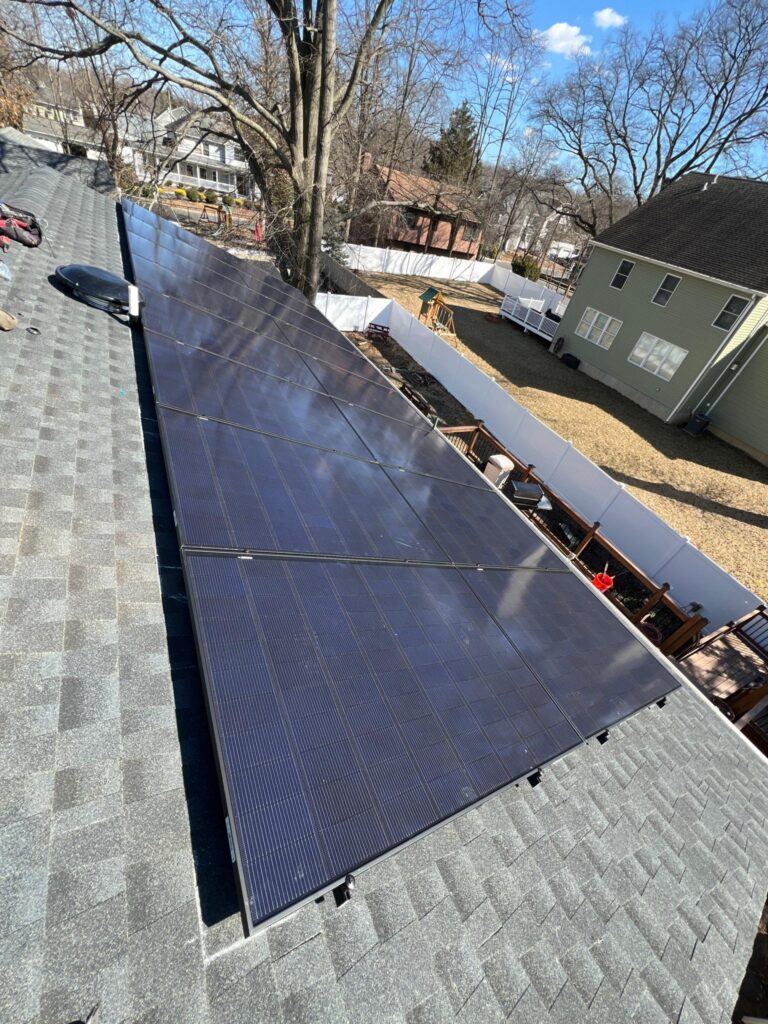


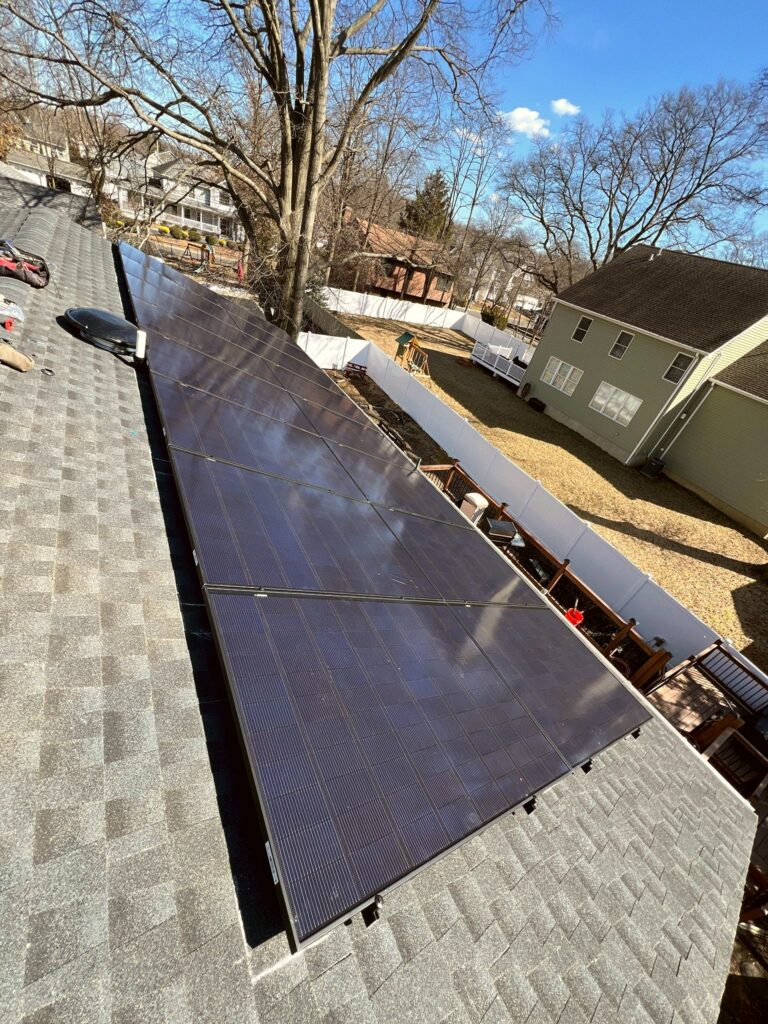
16-panel 7.36 kW solar array in Middletown, NJ by Green Sun Energy Services.
Kaitlin Campbell has been a Green Sun Energy Services client since February of 2025, when the roof and the solar array were bought on the same day. The roof was replaced first and the panels followed, both inside a week at the turn of February and March.
Three layers off, 1,600 square feet on
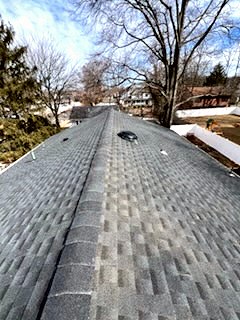
Most roofs on this site come off in one layer, and a fair number in two. This one came off in three. That means the original shingles had been covered over twice before anybody looked underneath, and it is a great deal more tear-off and disposal than the square footage suggests — 1,600 square feet of roof, three times over, into the dumpster. What went back on is a GAF Timberline HDZ system in Charcoal with a 50-year warranty, over deck protection on the exposed sheathing, with aluminum drip edge along 143 feet of rakes and eaves and a ridge vent along the peak.
Why three layers matters more when solar is coming
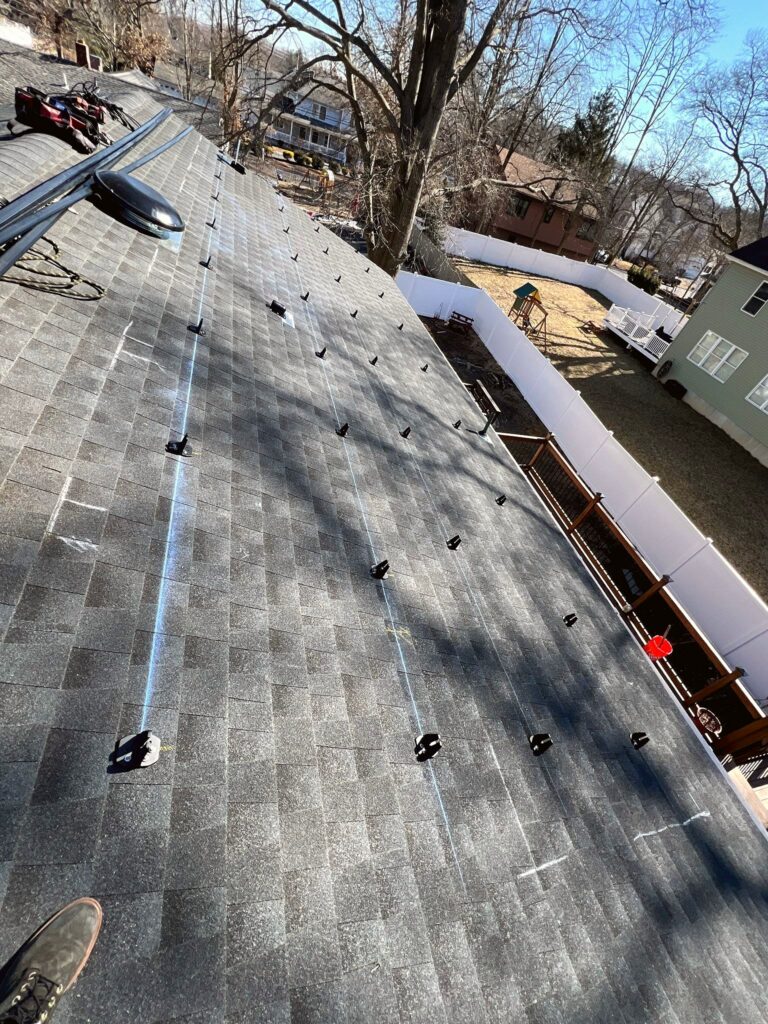
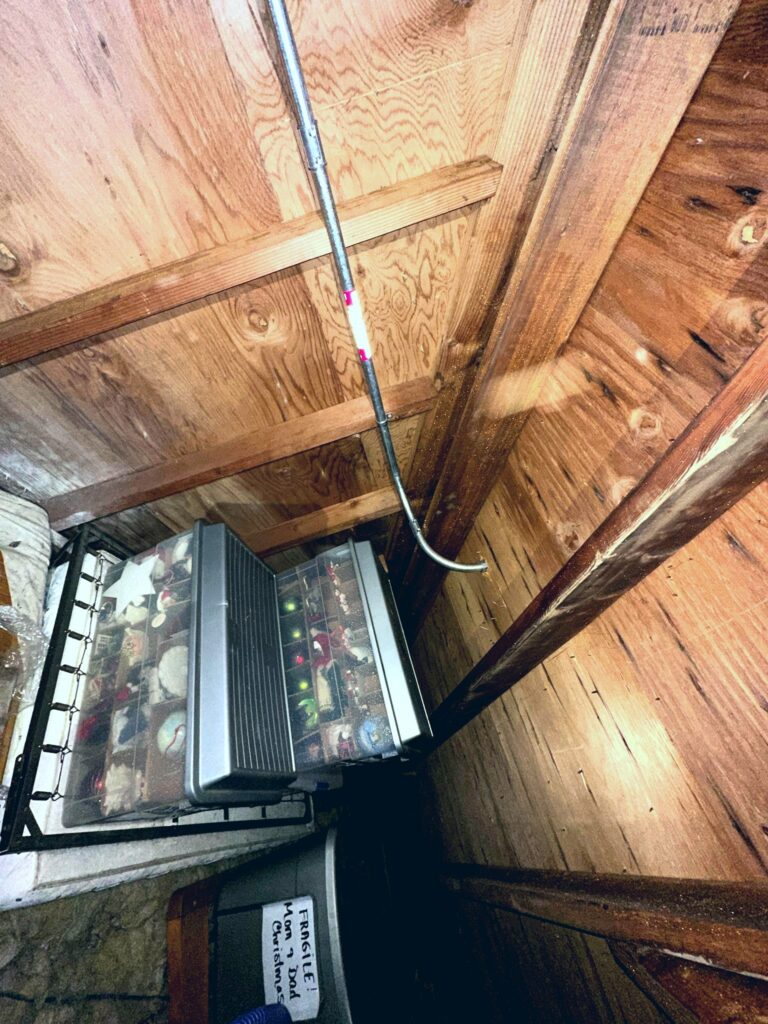
Every layer added to a roof adds weight and hides what is beneath it. A deck that has carried three courses of shingles has not been seen by anyone in decades, and it is about to have an array bolted through it for the next twenty-five years. Stripping to bare sheathing is the only way to know what those mounts are being fixed into. On a roof like this one, the tear-off is not the preliminary to the real work — it is the part that makes the rest of it defensible.
16 panels and 7.36 kW
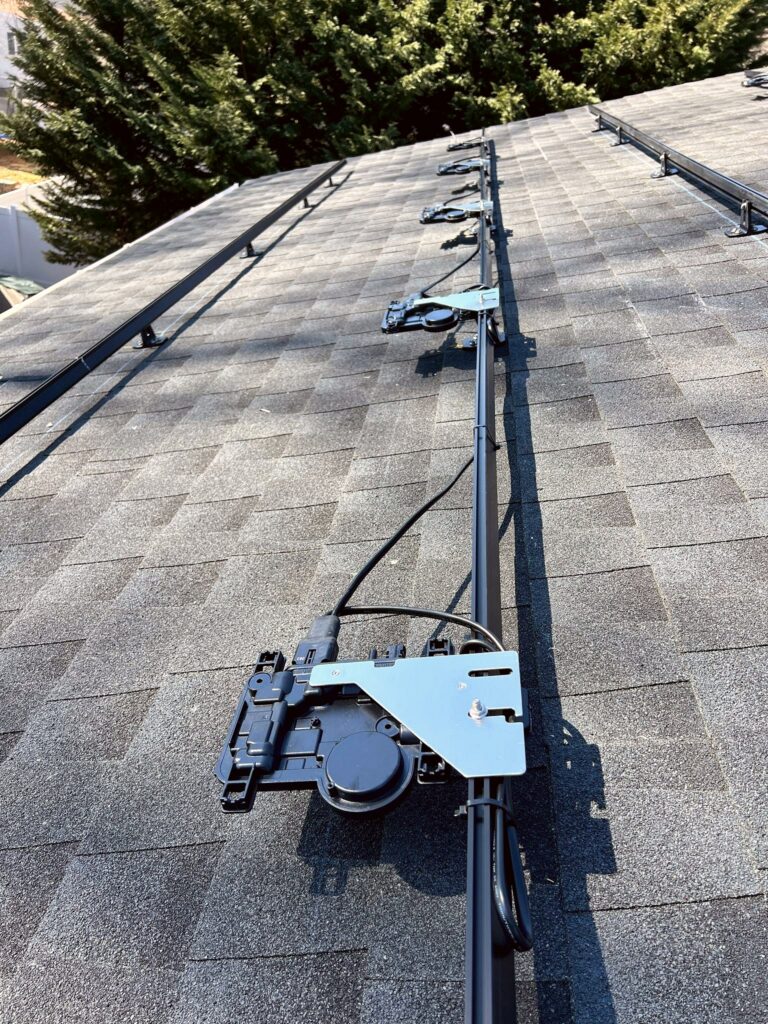
Sixteen REC 460 watt panels came to 7.36 kW on IronRidge mounting, each with its own Enphase IQ8X microinverter rather than a shared central inverter, so a panel in shade or one with a fault takes only itself out of the day. JCP&L is the utility and the first year was designed for about 8,065 kWh.
Why the roof went first
An array is bolted down for twenty-five years and more, so shingles at the end of their life underneath one become a second job with a date already on them — panels off, roof on, panels back. On a house already carrying three layers that job was not hypothetical; it was overdue. Buying both together meant one survey, one set of drawings, one inspection schedule, and a roofing crew that knew where every mount was going before the first shingle went down.
Why Middletown homeowners choose Green Sun Energy Services
One company designs the roof and solar system together, so there is no finger-pointing between a roofer and a solar installer.
What makes Green Sun Energy Services different
- Roofing: installed as a GAF Certified Roofing Contractor (#CE28608), with a GAF Timberline Lifetime Roofing System like the one on this home. On this home: a new roof over 1,600 sq ft.
- Solar: design and installation supervised by a NABCEP-certified professional (#PVA-111016-016148), with Enphase microinverters on every panel so each one reports its own output. On this home: a 7.36 kW solar array of 16 REC 460AA-PURE-RX-DC panels, an EnPhase IQ8X-80-M-US Micro-Single inverter and the IronRidge mounting system.
- Warranty: backed by a 50-year roof warranty, a 5-year roofing workmanship warranty and a 10-year solar workmanship warranty.
- Local: locally owned and operated in New Jersey since 2010, NJHIC licensed (#13VH06229000), with 32 completed roofing projects and 138 completed solar projects across Monmouth County and 92 roofing projects and 361 solar projects throughout New Jersey.
Our work in Middletown
Green Sun Energy Services has completed 5 roof replacements and 10 featured solar projects in Middletown. Middletown, a township on Raritan Bay and Sandy Hook Bay in Monmouth County, is served by JCP&L.
Generate electricity on your roof and use it to help power your vehicle.
Thinking about a new roof, solar, or both for your Middletown home? Tell us about your project here or call 732-410-7818.
Power it. Protect it. Maintain it.
Project Facts
- Location
- Middletown, NJ
- Services
- Roofing Installation, Solar Panel Installation
- Client since
- February 2025
Solar
- Manufacturer & model
- REC 460AA-PURE-RX-DC
- Panels
- 16
- System size
- 7.36 kW
- Inverter
- EnPhase IQ8X-80-M-US Micro-Single
- Mounting system
- IronRidge
- Estimated first-year production
- 8,065 kWh
- Share of the home's electricity
- 71%
- Electric utility
- JCP&L
- Workmanship warranty
- 10 years
Roof
- System
- GAF Timberline Lifetime Roofing System
- Area replaced
- 1,600 sq ft
- Warranty
- 50 years
- Workmanship warranty
- 5 years
Questions from Middletown homeowners
SolarWhat is a microinverter and why use one per panel?
A microinverter is a small inverter installed at or near an individual module, so each panel converts on its own channel. That gives module-level visibility and limits the effect one underperforming panel has on the others around it.
SolarHow much does shade from mature Middletown trees affect production?
Shade can materially reduce production, particularly when it falls during the highest-production hours. Module-level electronics such as microinverters and optimizers reduce the effect of partial shading, but they cannot create sunlight where there is none. Significant shade should be modelled before any annual production figure is quoted.
RoofingCan moss damage a roof?
Moss can hold moisture against shingles and lift edges as it grows. Shaded, tree-covered New Jersey properties are more prone to moss, so safe removal and control of moisture and debris are important.
RoofingWhat happens if rotten plywood is found during a roof replacement?
Damaged or deteriorated roof sheathing should be replaced so the new roofing system has a solid fastening surface.
RoofingCan gutters help prevent basement water problems?
Properly functioning gutters and downspouts can help reduce the amount of roof water deposited near the foundation. They cannot correct every basement water problem. Groundwater, grading, foundation cracks and drainage systems may also be involved.