


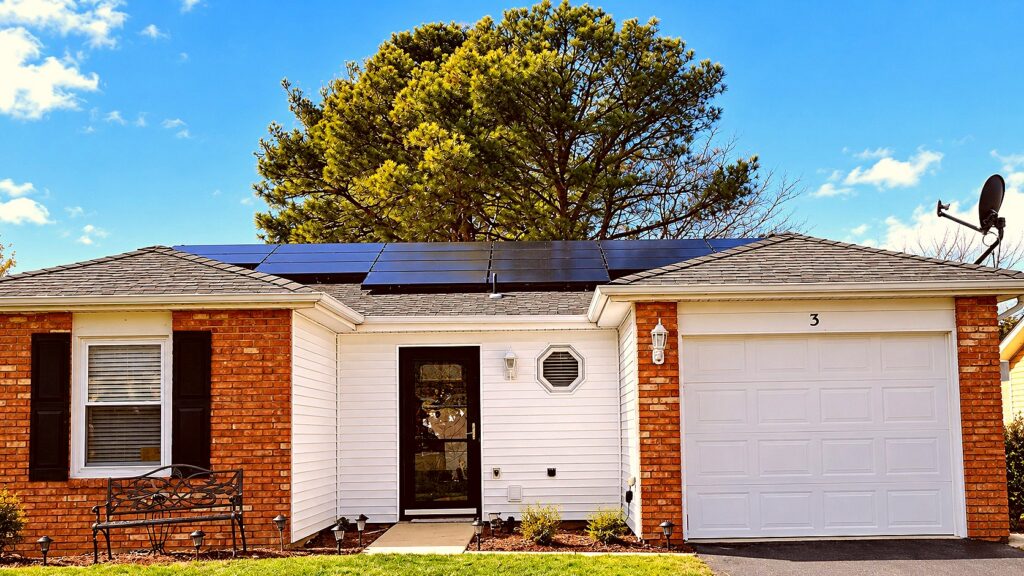

Solar Panel Installation and Solar Removal/Replacement in Brick, NJ by Green Sun Energy Services.
Carleen and Rick from Brick, NJ have been Green Sun Energy Services clients since December of 2016. The array went up that winter and came back to us three years later for a rebuild due to storm damage to their roof.
12.6 kW of solar
Forty-two LG 300-watt panels in all black, on a QuickMount mounting system, commissioned in December of 2016. First-year production was modeled at 15,251 kWh, which makes this one of the larger residential arrays in the set.
Removed and replaced
In November of 2019 the array was taken down and rebuilt at 10.71 kW. A remove and replace is ordinary work on a roof that has reached the end of its life: the panels come off, the roof is dealt with, and the array goes back up. It is the reason a solar customer should think about roof age before the first panel is fitted rather than after.
Servicing
The array has been maintained since 2017, with visits completed through 2022.
Perfectly! Outstanding workmanship & over the top Customer Service!
Green Sun Energy Services replied
Thank you. Workmanship and service are the two halves we are judged on, and getting both right on the same job is the whole ambition. Thank you for choosing Green Sun Energy Services, and for putting it so generously.
Why Carleen and Rick chose Green Sun Energy Services
One company removes the solar, fixes the roof, corrects what is underneath and puts everything back right.
What makes Green Sun Energy Services different
- Solar: design and installation supervised by a NABCEP-certified professional (#PVA-111016-016148), with SolarEdge optimizers on every panel so each one reports its own output. On this home: a 12.6 kW solar array of 42 LG 300N1K-G4/All Black panels, a SolarEdge SE10000A-US000NNR2 Inverter (25Y) W/ P320 HD Wave inverter, the QuickMount mounting system and the panels removed and reinstalled.
- Warranty: backed by a 5-year solar workmanship warranty.
- Local: locally owned and operated in New Jersey since 2010, NJHIC licensed (#13VH06229000), with 48 completed solar projects across Ocean County and 360 solar projects throughout New Jersey.
Our work in Brick
Green Sun Energy Services has completed 6 featured solar projects in Brick. Brick, a township on Barnegat Bay in Ocean County, is served by JCP&L.
Generate electricity on your roof and use it to help power your vehicle.
Thinking about solar for your Brick home? Tell us about your project here or call 732-410-7818.
Power it. Protect it. Maintain it.
Project Facts
- Location
- Brick, NJ
- Services
- Solar Panel Installation, Solar Removal/Replacement
- Client since
- December 2016
- Manufacturer & model
- LG 300N1K-G4/All Black
- Panels
- 42
- System size
- 12.60 kW
- Inverter
- SolarEdge SE10000A-US000NNR2 Inverter (25Y) W/ P320 HD Wave
- Mounting system
- QuickMount
- Estimated first-year production
- 15,251 kWh
- Share of the home's electricity
- 92%
- Electric utility
- JCP&L
- Workmanship warranty
- 5 years
Solar questions from Brick homeowners
Should the roof be replaced before the panels go on?
If the roof is near the end of its life, replacing it first is often the sensible order, because removing and reinstalling an array later adds labor and materials. The decision turns on roof age, shingle condition, any leaks, the decking, the remaining warranty and how long the solar system is expected to last.
How does residential solar work on a Brick home?
The panels convert sunlight into direct-current electricity, and an inverter or microinverters convert that into alternating current the house can use. When the array produces more than the house is drawing, the surplus flows out through the utility meter under New Jersey's net-metering rules. When the house needs more than the array is making, the difference comes from the utility.
Can more solar be installed than the house uses?
New Jersey's net-metering rules generally limit a residential customer's generating capacity by reference to the electricity supplied to that customer over an annualised period. The programme is designed to offset a household's own consumption rather than turn it into a wholesale generator. Documented future loads can sometimes be relevant under the utility's procedures.