

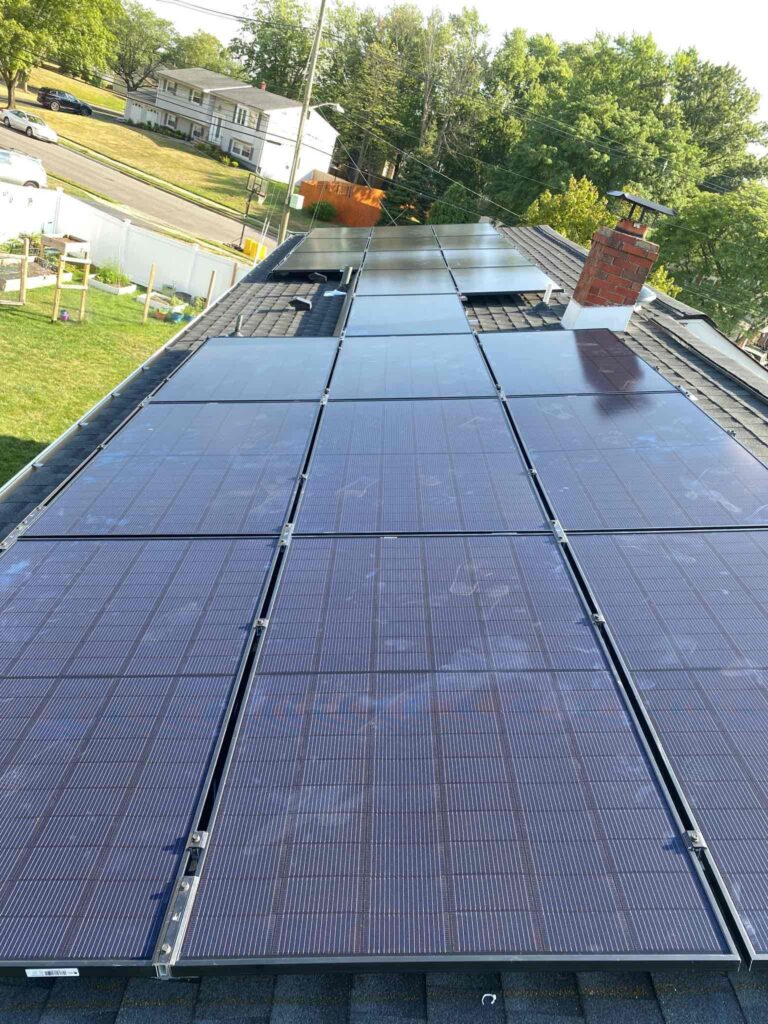
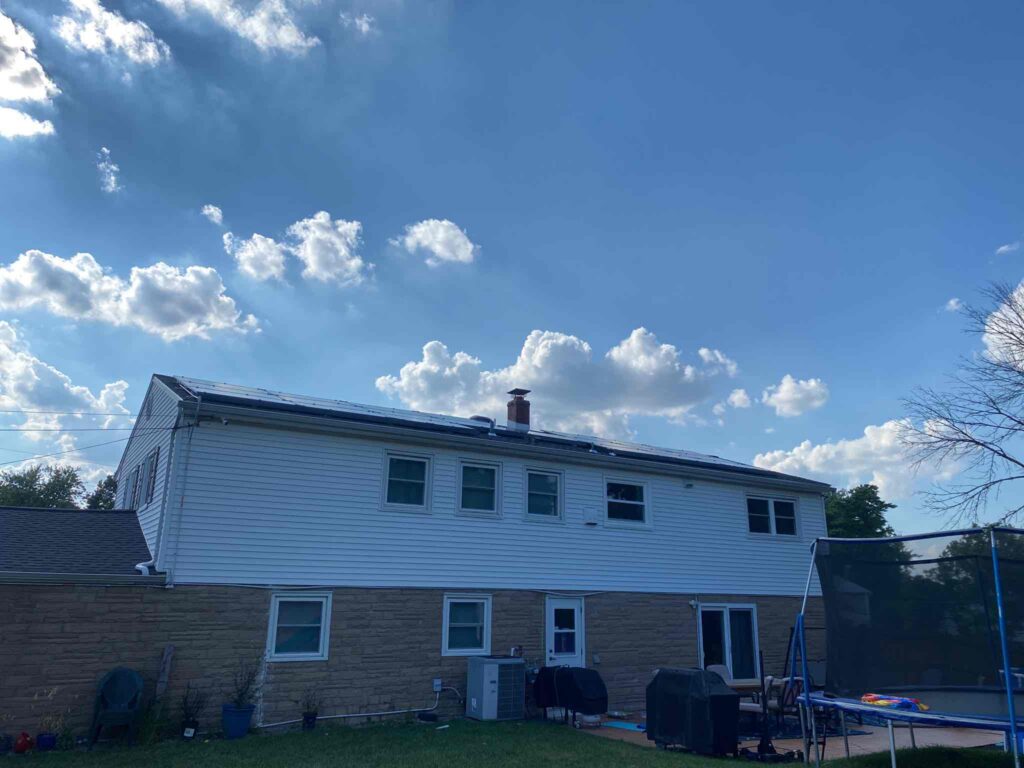
21-panel 7.77 kW solar array in East Brunswick, NJ by Green Sun Energy Services.
Michael from East Brunswick, NJ has been a Green Sun Energy Services client since May of 2022, and came back for a car charger three years later. The roof and the array were really one project carried out in two visits twelve days apart. The charger, in 2025, is the one with something to teach.
2,900 square feet of new roof
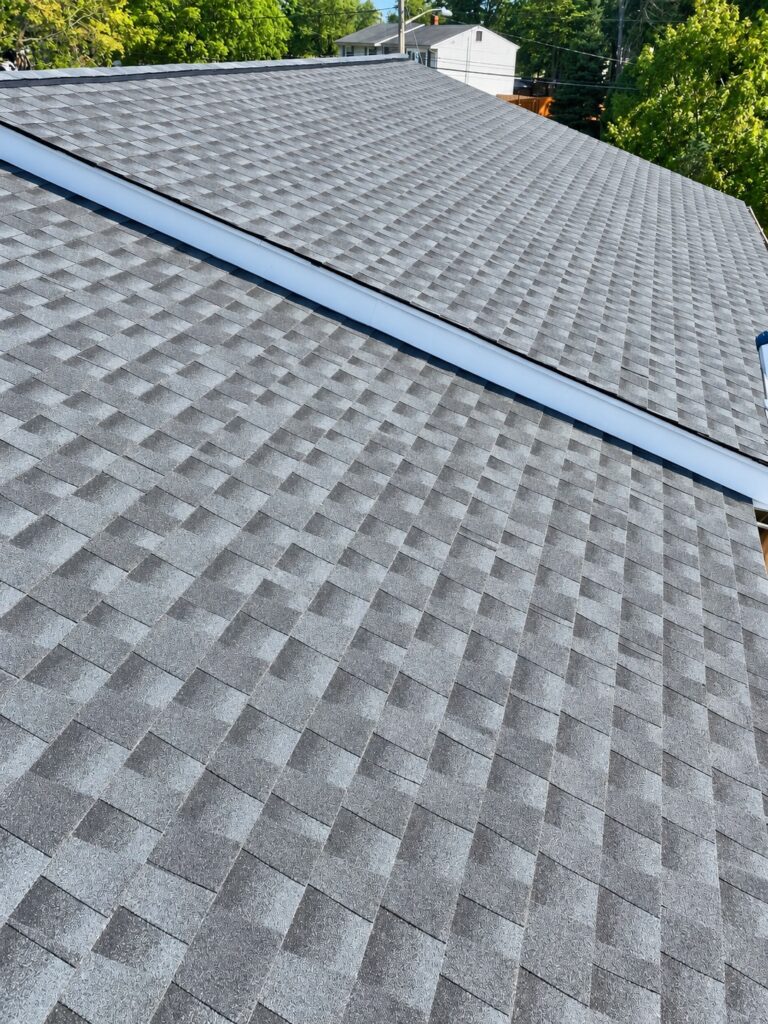
Finished on 25 July 2022: a single layer stripped to the sheathing and carted away rather than covered over, then 2,900 square feet of composition shingle in charcoal, warranted fifty years, with screened aluminum soffit vents at the intake.
21 panels and 7.77 kW
Twelve days later the array went up – 21 REC 370-watt modules on a SolarEdge Energy Hub inverter, 7.77 kW rated, estimated at 9,512 kilowatt hours in the first year and interconnected by PSE&G that September. A hundred and forty-four feet of critter guard went on around it.
A charger, and the calculation that came first
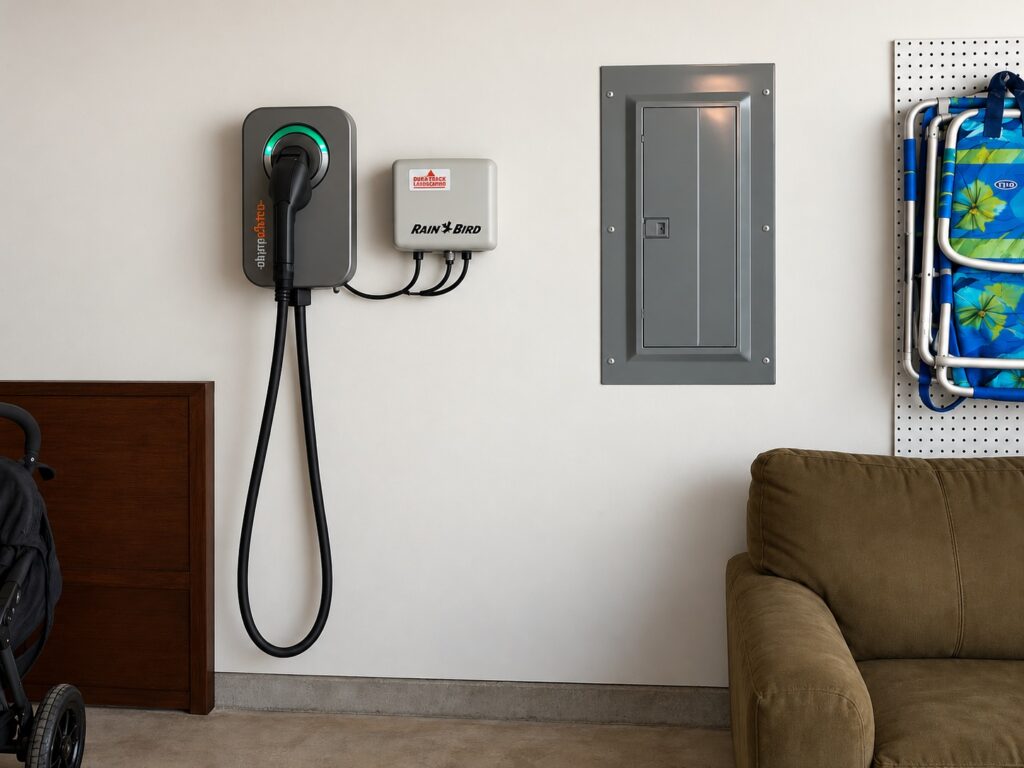
The house is 2,459 square feet with two refrigerators, a freezer, a dishwasher, a washer and a gas dryer, and at the time of the survey it sat on a 100-amp service. The load calculation for adding a car charger came out at 121 amps – more than a 100-amp panel is rated to carry, and not a number anybody can design their way around. So the service was upgraded to 200 amps first, and the charger went in afterwards, in October of 2025: a ChargePoint on a dedicated 60-amp circuit at 11.5 kW, roughly 36 miles of range an hour, taking the place of a two-pole breaker that had been feeding a 240-volt outlet.
That is what a load calculation is for. Done properly it delivers the uncomfortable news early, while it is still a scheduling question and a decision the homeowner gets to make. Skipped, the same fact turns up later as a breaker that will not stay in, or as a correction notice from an inspector.
Why the second visit was easier than the first
Three years separate the array from the charger, and the later job was the simpler one despite needing more work. The 2025 calculation was done on a house whose electrical picture we already had – the array, its inverter, the service rating and everything hanging off it – which is what turned “this service has to go to 200 amps” into a conclusion reached in September rather than a surprise found in October. And the array sits on a roof laid twelve days before it, so the one event that would force all of this apart again, a reroof underneath a live system, is decades away.
Why Michael chose Green Sun Energy Services
One company designs the roof and solar system together, so there is no finger-pointing between a roofer and a solar installer.
Professional home EV charging made simple, from electrical design through final inspection.
What makes Green Sun Energy Services different
- EV charging: installed with certifications from Qmerit, ChargePoint, Enphase, SolarEdge and Tesla, by a licensed electrician and fully managed by our team. On this home: a ChargePoint CPH50-HARDWIRE-L23 EV charger on a 60-amp circuit.
- Roofing: installed as a GAF Certified Roofing Contractor (#CE28608), with a GAF Timberline Lifetime Roofing System like the one on this home. On this home: a new roof over 2,900 sq ft.
- Solar: design and installation supervised by a NABCEP-certified professional (#PVA-111016-016148), with SolarEdge optimizers on every panel so each one reports its own output. On this home: a 7.77 kW solar array of 21 REC REC370AA-PURE panels, a SolarEdge SE7600H-USNBBL14 HD Wave Energy Hub inverter, the Snap-N-Rack mounting system and 144 ft of critter guard.
- Warranty: backed by a 50-year roof warranty, a 5-year roofing workmanship warranty and a 25-year solar workmanship warranty.
- Local: locally owned and operated in New Jersey since 2010, NJHIC licensed (#13VH06229000), with 11 completed EV charger projects, 12 completed roofing projects and 48 completed solar projects across Middlesex County and 91 EV charger projects, 91 roofing projects and 360 solar projects throughout New Jersey.
Our work in East Brunswick
Green Sun Energy Services has completed 1 EV charger installation, 3 roof replacements and 10 featured solar projects in East Brunswick. East Brunswick, a township in Middlesex County, is served partly by JCP&L and partly by PSE&G.
Protect the investment you've made in your home's exterior.
Thinking about a new roof, solar, or an EV charger for your East Brunswick home? Tell us about your project here or call 732-410-7818.
Power it. Protect it. Maintain it.
Project Facts
- Location
- East Brunswick, NJ
- Services
- EV Charger Installation, Roofing Installation, Solar Critter Guard, Solar Panel Installation
- Client since
- May 2022
Solar
- Manufacturer & model
- REC REC370AA-PURE
- Panels
- 21
- System size
- 7.77 kW
- Inverter
- SolarEdge SE7600H-USNBBL14 HD Wave Energy Hub
- Mounting system
- Snap-N-Rack
- Estimated first-year production
- 9,512 kWh
- Share of the home's electricity
- 99%
- Electric utility
- PSE&G
- Critter guard fitted
- 144 ft
- Workmanship warranty
- 25 years
EV charger
- Manufacturer & model
- ChargePoint CPH50-HARDWIRE-L23
- Charging port
- CCS (J1772)
- Circuit breaker
- 60 amp
- Charging stations
- 1
- Estimated range added per hour
- 36 mi / 58 km
Roof
- System
- GAF Timberline Lifetime Roofing System
- Area replaced
- 2,900 sq ft
- Warranty
- 50 years
- Workmanship warranty
- 5 years
Questions from East Brunswick homeowners
SolarCan the panels come off and go back on for a new roof?
Yes -- it is commonly called a removal and replacement. The work involves taking off the modules and mounting equipment, protecting the electrical equipment, roofing, fitting new attachments, rewiring, reinstalling, testing and recommissioning. Permitting and utility requirements are reviewed where the configuration changes.
SolarWhat is rapid shutdown?
A code safety requirement intended to reduce hazardous voltage in controlled areas of a rooftop array during an emergency -- so that firefighters are not working around energised conductors. Modern residential systems achieve it with compliant module-level electronics and listed inverter equipment.
RoofingCan moss damage a roof?
Moss can hold moisture against shingles and lift edges as it grows. Shaded, tree-covered New Jersey properties are more prone to moss, so safe removal and control of moisture and debris are important.
RoofingHow long should an asphalt shingle roof last in East Brunswick, NJ?
There is no single guaranteed service life. Longevity depends on the shingles, the installation, ventilation, weather exposure and maintenance. New Jersey roofs face summer heat, freezing temperatures, snow, ice, heavy rain, wind, humidity and, in some areas, coastal salt. A properly installed architectural roofing system should be judged against the manufacturer's warranty and installation requirements rather than a generic life-expectancy number.
RoofingCan I match new shingles to an older roof section?
Exact matching is difficult because older shingles fade and manufacturers change colors and product lines. Even the same named color may look different next to weathered material.
EV chargingWhat does hardwiring the charger mean in practice?
The charger is wired directly to the branch circuit rather than plugged into a receptacle. That removes a high-current plug and socket from a connection that carries a heavy load for hours at a time, allows the equipment's full range of output settings, and makes for a cleaner installation outdoors.
EV chargingCan an EV charger be installed on a driveway pedestal?
Yes. A pedestal installation can work well where the house wall is too far away or parking is detached. It may require trenching, conduit, a weather-rated charger, physical protection, and careful placement so cords do not cross sidewalks or create trip hazards.