#MonmouthCountyNJ

Illustration for the article Iran’s Cyberattacks on US Infrastructure: Why NJ Homeowners Need a Standby Generator

Iran’s Cyberattacks on US Infrastructure: Why NJ Homeowners Need a Standby Generator

Summary In the fall of 2024, NBC News reported that Iranian hackers had targeted not only U.S. water systems but also the country’s telecommunications, energy, and other critical infrastructure — with an Iranian hacking group threatening that “unexpected and critical events” would soon strike American energy, water, and telecommunications industries. While those specific intrusion attempts were unsuccessful, the threat has not faded. Federal agencies including CISA, the FBI, and the NSA have continued to issue advisories through 2025 and 2026 warning that Iran-affiliated actors are actively exploiting internet-connected industrial control systems at U.S. utilities. The threat is not hypothetical. CISA

Illustration for the article PJM’s December 2025 Capacity Auction Left a 6,600 MW Gap: What NJ Homeowners Need to Know

PJM’s December 2025 Capacity Auction Left a 6,600 MW Gap: What NJ Homeowners Need to Know

Summary In December 2025, PJM Interconnection — the grid operator that keeps the lights on for more than 67 million people across 13 states, including New Jersey — held its 2027/2028 Base Residual Auction. The result was historic in the worst way: the auction cleared at the FERC-approved price cap of $333.44 per megawatt-day and still fell 6,623 MW short of PJM’s own reliability requirement — the first time in the capacity market’s 18-year history that it had missed its target. For a Monmouth County homeowner, those numbers translate directly into your electric bill. New Jersey utilities buy power through

Illustration for the article NJ Windstorm Knocked Out Power to 48,000+ Homes in December 2025: What Monmouth County Homeowners Should Know Before Next Season

NJ Windstorm Knocked Out Power to 48,000+ Homes in December 2025: What Monmouth County Homeowners Should Know Before Next Season

Summary On Friday, December 19, 2025, a High Wind Warning swept across New Jersey with gusts approaching 60 mph, toppling trees, downing power lines and leaving over 48,000 homes and businesses without electricity — not in a hurricane, not in a nor’easter, but in a fast-moving December wind event. Jersey Central Power & Light (JCP&L), the utility that serves all of Monmouth County, bore the heaviest load of that outage wave. JCP&L’s spokesperson later described it as one of the largest and most widespread windstorms to affect Monmouth and Ocean counties since Tropical Storm Isaias in 2020. The storm is

Illustration for the article New Jersey’s 2023 NEC Is Now in Force: What It Means for Your Generator Install

New Jersey’s 2023 NEC Is Now in Force: What It Means for Your Generator Install

Summary New Jersey’s electrical subcode changed on August 17, 2026, when the state officially replaced the 2020 National Electrical Code with the 2023 edition as part of a broader update to its Uniform Construction Code. For homeowners planning a Generac standby generator installation in Monmouth County or anywhere else in the state, that date matters because the edition governing your permit shapes the technical requirements your contractor must meet — from how the transfer switch is specified to how the generator is sized. The two sections with the most direct impact on a residential install are NEC 702.4 (System Capacity)

Illustration for the article NJ Assembly Bill A4405: Could It Remove the Zoning Hurdle for Your Standby Generator?

NJ Assembly Bill A4405: Could It Remove the Zoning Hurdle for Your Standby Generator?

Summary A New Jersey Assembly bill introduced in February 2026 could make it significantly easier for homeowners to install a whole-home standby generator. Assembly Bill A4405, sponsored by Assemblyman Webber in the 222nd Legislature, would classify automatic standby generators as a permitted use in every residential zoning district in New Jersey, eliminating the need to apply to a local planning or zoning board for a variance. Under the bill, a generator that meets the local accessory-structure setback requirements would need only the approval of the municipal zoning officer — not a full board application. If the property cannot meet those

Illustration for the article Why November Rooflines in Monmouth County Make DIY Light Hanging Genuinely Risky

Why November Rooflines in Monmouth County Make DIY Light Hanging Genuinely Risky

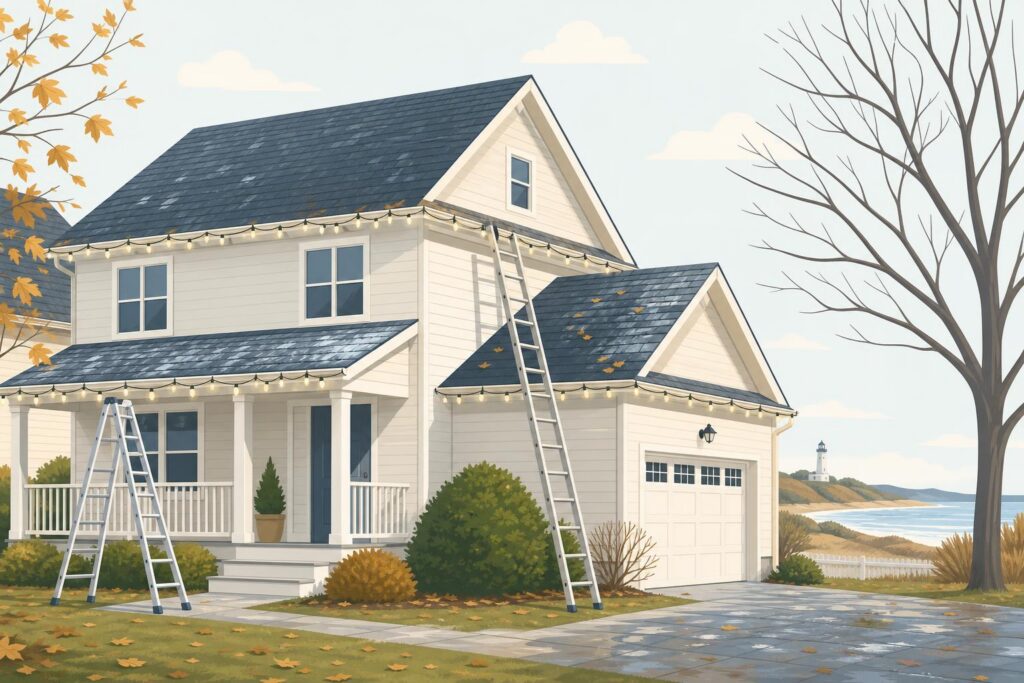
Summary Every November, thousands of New Jersey homeowners pull a ladder out of the garage and start hanging Christmas lights. It feels like a routine chore, and for a single-story ranch on flat ground on a dry afternoon it largely is. But the conditions in Monmouth County from mid-November onward — overnight frost, wet asphalt shingles, uneven lawn edges, and brisk winds off the coast — are not routine. They compound the ordinary risks of ladder work in ways that are worth understanding before you decide whether to climb. According to the U.S. Consumer Product Safety Commission, roughly 14,900 people

Illustration for the article How Your HOA Rules Affect Holiday Light Installation in Monmouth County

How Your HOA Rules Affect Holiday Light Installation in Monmouth County

Summary If you live in an HOA-governed community in Monmouth County, the rules that govern your holiday light display are almost certainly more detailed than you expect. Associations can regulate when lights go up and come down, what colors are permitted on the front elevation, how many feet of lights are allowed, how the strands are attached to your home, and whether a permanent LED roofline system requires a separate architectural review. Those rules live in your CC&Rs and community bylaws, not in any single easy-to-find place, which means most homeowners only discover a problem after a violation notice arrives

Illustration for the article What DIY Christmas Light Clips Actually Do to Your Gutters and Shingles

What DIY Christmas Light Clips Actually Do to Your Gutters and Shingles

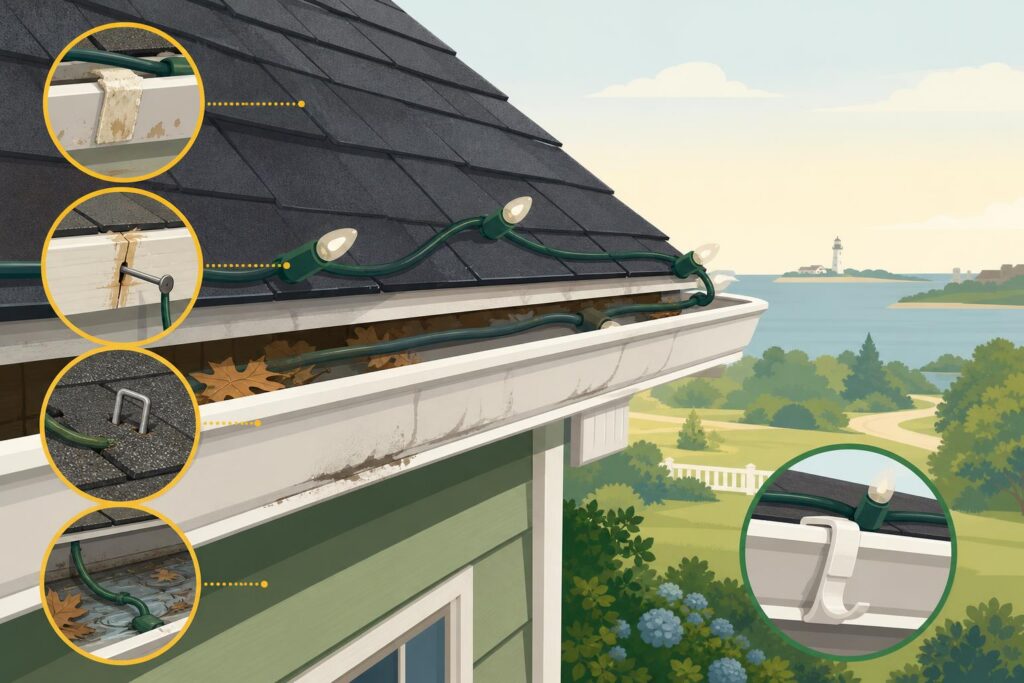
Summary Every November, homeowners across Monmouth County drag out the light strands and reach for whatever is handy — a staple gun, a box of roofing nails, a roll of adhesive hooks from the hardware store. The display goes up in an afternoon. The damage it causes may not show up until the following spring, when a roofing contractor finds punctured shingles, a stripped gutter finish, a rotting fascia board, or a section of trough that can no longer drain properly. The core problem is that a residential roofing system is engineered to manage water, not to serve as a

Lightscaping Is the 2025 Holiday Trend Replacing the Plain Roofline Outline

Summary For decades, the standard holiday display on a New Jersey home meant one horizontal strip of lights clipped to the gutters. In 2025, installers and homeowners alike are moving on. The approach drawing the most attention this season is called lightscaping — a method that blends roofline lighting with wrapped trees, illuminated pathways, architectural uplighting, and framed windows to create a layered, dimensional display rather than a single flat outline. The result looks less like a seasonal add-on and more like a designed exterior that happens to celebrate the holidays. The term is catching on across the industry. As

Illustration for the article Why Enphase Panels Next to Each Other Produce Differently — And Why Microinverters Beat String Inverters

Why Enphase Panels Next to Each Other Produce Differently — And Why Microinverters Beat String Inverters

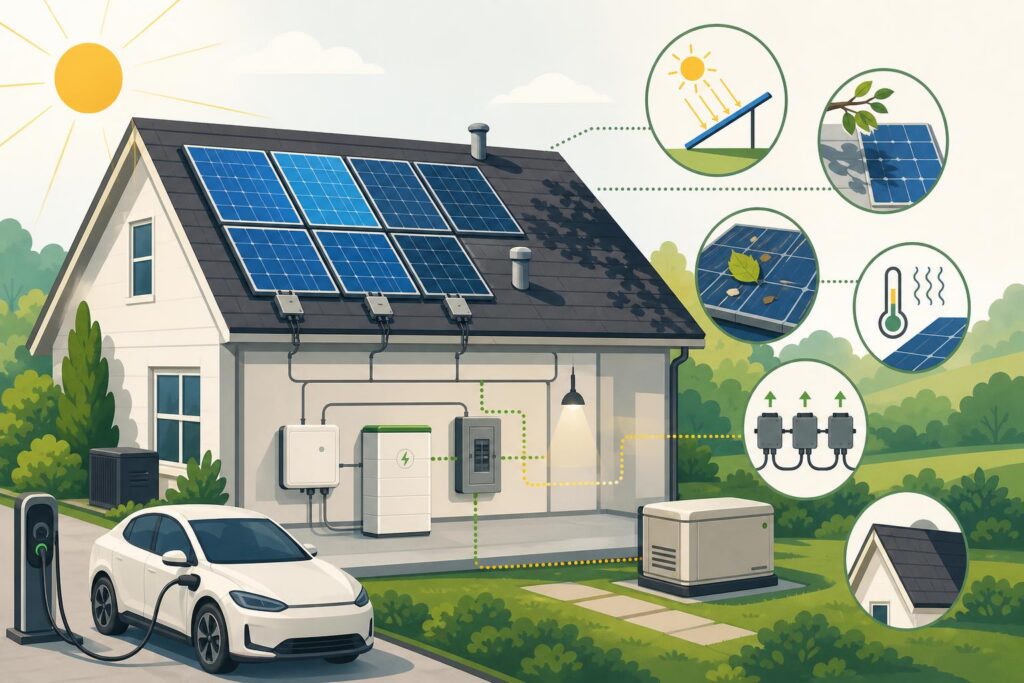
Summary You open the Enphase app, tap over to the Array view, and notice something that looks wrong: two panels sitting right next to each other on the same roof slope are showing noticeably different numbers. Before you call for a service visit, it helps to understand that some variation between adjacent panels is completely normal — and that reading the app correctly matters as much as reading the panels themselves. Solar systems installed by Green Sun Energy Services in Monmouth County use Enphase microinverters precisely because that panel-level data is available in the first place, which gives homeowners and

Scroll to Top