

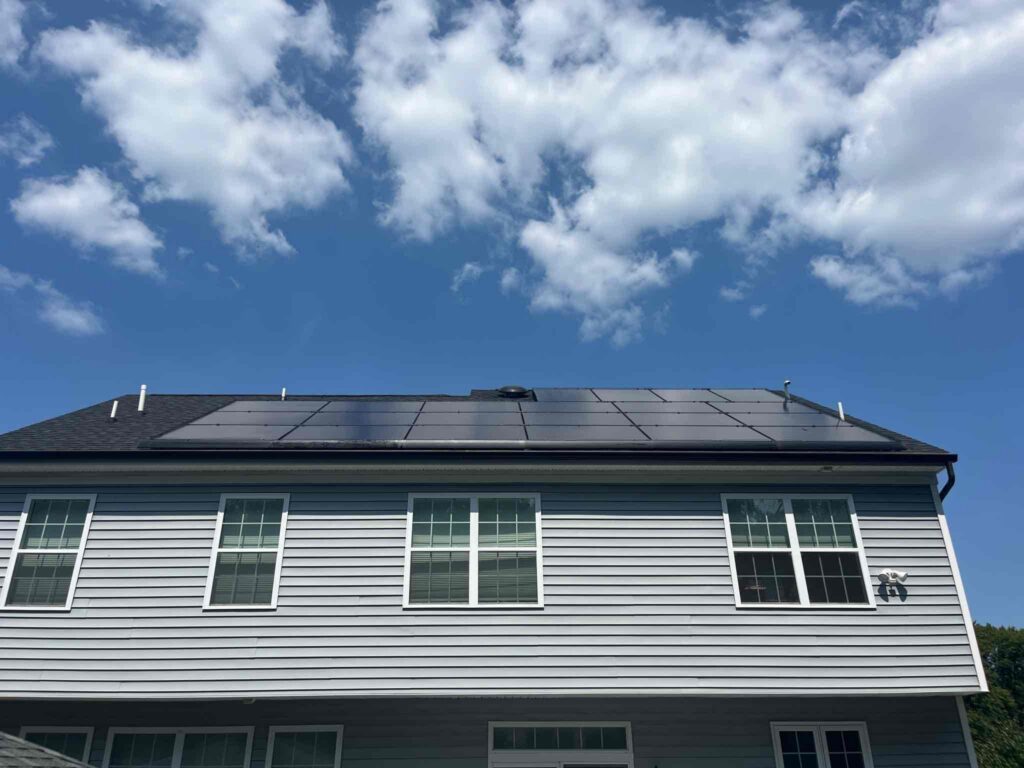
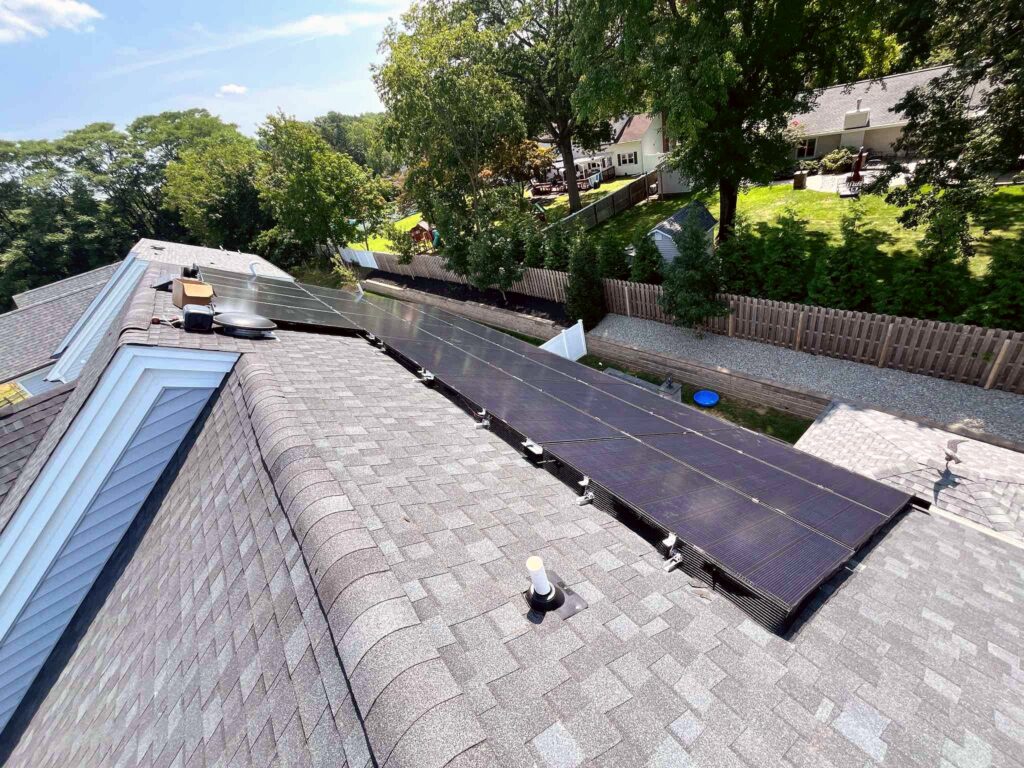

22-panel 10.12 kW solar array in Middletown, NJ by Green Sun Energy Services.
Anthony in Middletown has been a Green Sun Energy Services client since June of 2024. He signed for the standby generator and the solar array on consecutive days; the generator was commissioned on 13 August 2024 and the array a fortnight later.
22 panels, and five vent pipes moved
Twenty-two REC 460-watt panels, 10.12 kW in total, on Snap-N-Rack mounting with a SolarEdge SE7600H Energy Hub inverter and an optimizer on every panel. Estimated first-year production is 13,162 kWh and the utility is JCP&L.
Part of the work had nothing to do with electricity. Up to five plumbing vent pipes were relocated to clear the array.
Vent pipes are the most common obstruction on a residential roof and the least considered. They stand a foot or two proud of the shingles, they are placed wherever the plumbing beneath them happened to run, and they are almost always in the middle of the best south-facing section. A layout that works around them loses panels or leaves awkward gaps; moving them means opening the roof, rerouting the pipe in the attic, and flashing the new penetration properly so it does not leak in ten years.
It is the sort of work that is invisible in the finished photograph and decides how many panels actually fit.
A 22 kW machine on a 150-amp service
The house is 2,100 square feet on a 150-amp service. Its electrical calculation comes to 23,976 watts, and 6,000 watts of air conditioning is taken off the top while the generator is running, leaving 17,976 to hold. The machine is a Generac Guardian 22 kW, model 7042-2, delivering 19.5 kW on natural gas — above both the load it carries and the 18 kW the code calculation sets as a minimum.
The transfer switch is service-rated at 150 amps, matched to the service rather than to the generator, with surge protection built in. It was last serviced on 17 August 2026.
Room for what comes next
The inverter on this roof is a SolarEdge Energy Hub, and that choice is the interesting one, because it is not the cheapest way to convert direct current into alternating current. It is the platform that accepts a battery later without replacing the inverter.
Nothing was stranded by installing it. The array works exactly as any grid-tied array works, and — like every grid-tied array — it shuts down when the utility supply fails, because it must not energise a line a crew is working on. The generator does the outage work today and does it well.
What the Energy Hub buys is optionality. If this household decides in five years that they want the array to carry some of the load during a daytime outage, or to store the afternoon’s production for the evening, that becomes an addition rather than a rebuild. Most houses that reach that decision discover their inverter cannot get there and the answer is to start again.
Choosing hardware that does not foreclose the next decision is a small thing at the point of installation and a large one afterwards.
Why Middletown homeowners choose Green Sun Energy Services
More than solar panels: a professionally managed energy system, from design and permitting through installation, inspection, activation and ongoing support.
Complete backup power, from sizing and installation to the service that keeps it ready.
What makes Green Sun Energy Services different
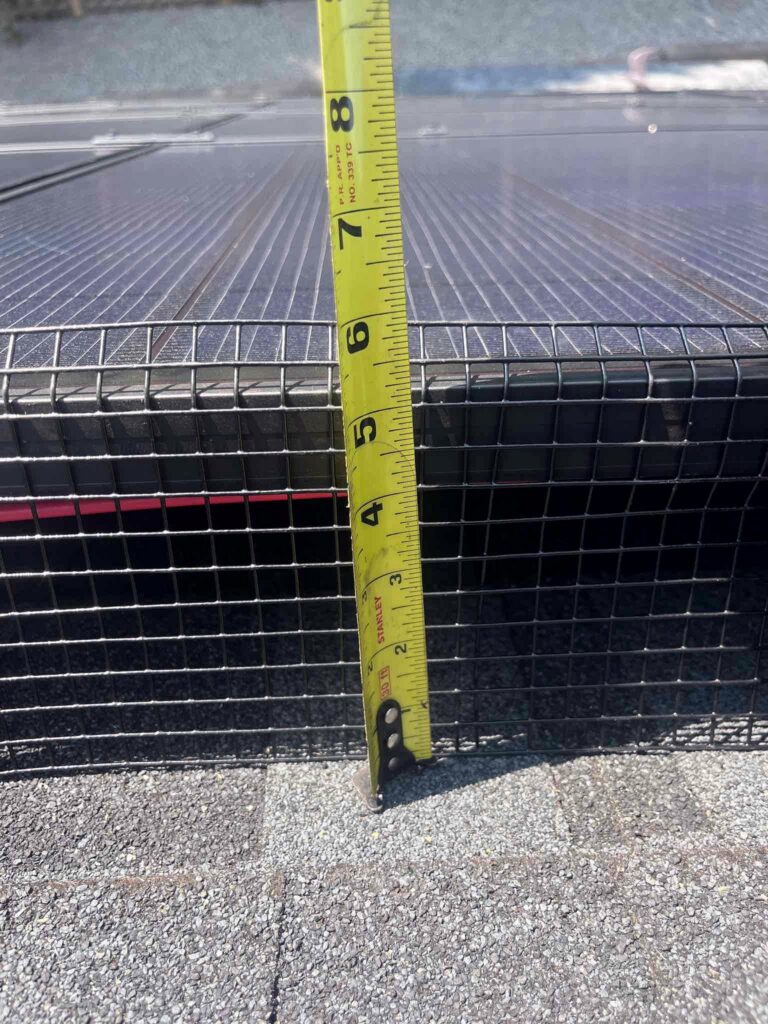
- Solar: design and installation supervised by a NABCEP-certified professional (#PVA-111016-016148), with SolarEdge optimizers on every panel so each one reports its own output. On this home: a 10.12 kW solar array of 22 REC 460AA-PURE-RX-DC panels, a SolarEdge SE7600H-USNBBL14 HD Wave Energy Hub inverter, the Snap-N-Rack mounting system and 104 ft of critter guard.
- Standby generators: installed and serviced as a Generac Authorized Sales and Service Dealer, by factory-authorized Generac technicians. On this home: a Generac 7042-2 standby generator (22 kW LP / 19.5 kW NG) running on natural gas, on a 150-amp transfer switch (managed whole house) and serviced by Green Sun Energy Services.
- Warranty: backed by a 25-year solar workmanship warranty and a 5-year generator workmanship warranty.
- Local: locally owned and operated in New Jersey since 2010, NJHIC licensed (#13VH06229000), with 138 completed solar projects and 444 completed standby generator projects across Monmouth County and 361 solar projects and 621 standby generator projects throughout New Jersey.
Our work in Middletown
Green Sun Energy Services has completed 10 featured solar projects, 72 standby generator installations and 120 generator service customers in Middletown. Middletown, a township on Raritan Bay and Sandy Hook Bay in Monmouth County, is served by JCP&L.
Generate electricity on your roof and use it to help power your vehicle.
Thinking about solar, a standby generator, or both for your Middletown home? Tell us about your project here or call 732-410-7818.
Power it. Protect it. Maintain it.
Project Facts
- Location
- Middletown, NJ
- Services
- Solar Critter Guard, Solar Panel Installation, Standby Generator Installation, Standby Generator Service
- Client since
- June 2024
Solar
- Manufacturer & model
- REC 460AA-PURE-RX-DC
- Panels
- 22
- System size
- 10.12 kW
- Inverter
- SolarEdge SE7600H-USNBBL14 HD Wave Energy Hub
- Mounting system
- Snap-N-Rack
- Estimated first-year production
- 13,162 kWh
- Share of the home's electricity
- 100%
- Electric utility
- JCP&L
- Critter guard fitted
- 104 ft
- Workmanship warranty
- 25 years
Standby generator
- Manufacturer & model
- Generac 7042-2
- Rated output
- 22 kW LP / 19.5 kW NG
- Fuel
- Natural Gas
- Home sized for
- 2,100 sq ft
- Electrical service
- 150 amp
- Transfer switch
- 150 amp
- Load management
- Managed Whole House
- Workmanship warranty
- 5 years
Questions from Middletown homeowners
Standby generatorDoes a 200-amp service need a 200-amp transfer switch?
A transfer switch installed in the service path has to be rated appropriately for the service and the configuration. A 200-amp service commonly uses a 200-amp service-rated switch, but the actual design is confirmed by the electrician rather than assumed from the service size.
Standby generatorCan Middletown require a generator to sit farther from the house than the manufacturer does?
Yes. Another applicable requirement can result in greater separation than the manufacturer's listed minimum -- equipment may be permitted eighteen inches from a qualifying wall while the local ordinance requires several feet from a property line. Both requirements have to be satisfied; neither cancels the other.
Standby generatorHow is the gas pipe size worked out?
From the generator's demand, the available pressure, the pipe length, the allowable pressure drop, the fittings, the pipe material and every other appliance connected to the system. The adopted fuel-gas code carries the sizing requirements and tables, and the model's published fuel consumption goes into the calculation.
SolarWhat does the inverter do?
It converts the direct current the panels produce into alternating current the house and the grid can use. Residential systems generally use either a central inverter, with optimizers at the modules where applicable, or a microinverter at each module.
SolarCan New Jersey change its net-metering rules?
Yes. Energy statutes, Board of Public Utilities regulations and utility tariffs can all change. A proposal should describe the rules as they currently stand rather than guarantee that they will hold for decades.